Showing posts with label fred macmurray. Show all posts

Thursday, 2 November 2023

Noirvember: Pushover (1954)

A man and a woman meet in the kind of encounter that could lead to the 1950s version of a rom-com. She is having car trouble. He can offer her somewhere to stay while it gets fixed. But she may have another man in her life. And, as viewers find out in the next scene, her latest admirer is actually a cop. 

Directed by Richard Quine, Pushover is an enjoyable film noir that pairs up Fred MacMurray (as Paul Sheridan, the cop) and Kim Novak (as Lona McLane), allowing them to struggle against their attraction as if both were magnets trying to join together as opposing forces keep showing how they should stay apart. McLane is a woman who is due a visit from her fella, a criminal who has hidden the money from a recent bank robbery somewhere, and Sheridan is one of the cops trying to ensure his arrest, but love complicates the whole situation. And greed. Love and greed. A classic film noir combination.

While not as dark and gritty as many other film noirs, Pushover is an excellent depiction of a man making one bad decision and then seeing events spiral way out of his control, causing the kind of damage that he soon realises there’s no coming back from. Apparently based on a couple of different source texts (“The Night Watch”, by Thomas Walsh, and “Rafferty”, by William S. Ballinger), the script by Roy Huggins continually builds momentum as everyone is dragged towards a tense finale. Quine ensures that everyone can see the pieces moving into place, and he does so without anything feeling rushed or illogical.

MacMurray does a great job of being the dependable guy we’ve seen him play in so many other movies (a man without malicious intent who is changed by the unfolding chain of events that he kickstarted), and Novak is already a shining star in her first credited feature role. If anyone is going to get themselves in big trouble then doing so for Novak feels like pretty good motivation. Philip Carey, Allen Nourse, and E. G. Marshall make up other members of the force who are focused on cracking the case, and all of them do well in very stereotypical roles, and Dorothy Malone stands out as a woman who inadvertently puts a spanner in the works of the unstoppable scheme.

This is never going to crack a list of top 10 film noirs, I doubt it would even crack a top 50, but Pushover is well worth your time. The leads have great chemistry, the supporting characters are all memorable in the right ways, and the tension keeps getting ratcheted up nicely as soon as one small error creates a tragic butterfly effect. I REALLY liked this, and hope others check it out.

8/10

If you have enjoyed this, or any other, review on the blog then do consider the following ways to show your appreciation. A subscription/follow costs nothing.
It also costs nothing to like/subscribe to the YouTube channel attached to the podcast I am part of - https://www.youtube.com/channel/UCErkxBO0xds5qd_rhjFgDmA
Or you may have a couple of quid to throw at me, in Ko-fi form - https://ko-fi.com/kevinmatthews
Or Amazon is nice at this time of year - https://www.amazon.co.uk/hz/wishlist/ls/Y1ZUCB13HLJD?ref_=wl_share

Friday, 30 December 2022

Remember The Night (1940)

I am sure that people who are already familiar with Remember The Night already notice when it starts to become a more popular viewing choice towards the end of the year (due to it being set during the Christmas holiday period). I wasn't familiar with the film before now, but I suddenly started noticing it everywhere. I can only imagine that it's a solid choice for some of the classic movie channels, and the recent (typically sublime) UK Blu-ray release from Indicator must have helped it become even more ubiquitous than usual this December.

Written by Preston Sturges and directed by Mitchell Leisen, all you should need to know to get you interested in Remember The Night is that it was the first movie to pair up Barbara Stanwyck and Fred MacMurray. It's not their best (because four years later they would work together in the classic Double Indemnity), but it's a very enjoyable use of their talents.

Stanwyck plays Lee Leander, a woman who has been arrested on a shoplifting charge. She did it, and she doesn't seem too remorseful about doing it, but MacMurray's prosecuting attorney, John Sargent, knows that a jury can be affected by seasonal goodwill just before Christmas, which is why he is happy to request a continuance of the trial until after the holidays. Unfortunately, with no family or funds available, this means that Miss Leander will spend the holiday season in jail. Sympathetic to her situation, especially as he caused it, Sargent manages to get her out on bail. Dropped off at his apartment, Miss Leander quickly ends up making Mr. Sargent regret his good deed. He is heading home for the holidays, and decides to take Miss Leander to her family, where she can enjoy some time before heading back for her assigned court date, and so begins a blossoming relationship that could cause hurt and happiness in equal measure.

The thing that works best about Remember The Night is that it's a message movie that delivers a message you might not actually expect. Yes, there are the usual enjoyable character interactions, and there's a fun set-piece or two (small in scale, but there throughout the runtime nonetheless), as well as the strengthening connection between the two leads, but this is a film that uses the goodwill of the season to reflect a light of joy/shame on the many supporting characters. Stanwyck's character is not pleading innocence throughout, nor does she ever really make any excuses for her own behaviour, but viewers, and those in the movie who get to know her without their view shaded by her arrest, can easily see that there is much more to define her than a penchant for thievery.

It helps, of course, that Stanwyck's character is played by Stanwyck, an actress who I've never known to disappoint (although I still have so many more of her movies to get around to). It also helps that MacMurray is putting in yet another of those winning turns that he delivered for a good few decades, making him easy to root for even when he might not have been consistently in the right. Beulah Bondi and Elizabeth Patterson are a delight as two members of Sargent's family (his mother and aunt, respectively), Georgia Caine plays a much-less-delightful mother to our female lead, and Willard Robertson, Sterling Holloway, and Charles Waldron all get at least one good moment. It's also worth mentioning the small role for Fred 'Snowflake' Toones, a character actor who may be involved a couple of scenes that disappointingly play to the prevailing attitude of the era, but who deserves to be namechecked nonetheless. (it's the writing/direction that disappoints there, not his performance)

It doesn't overdo the Christmas feeling, but you get it emanating from the screen at key points, making it easy to see why people may choose to keep this one in annual rotation. It delivers familiar good feeling with a satisfyingly unfamiliar sprinkling of realism . . . 1940s cinematic realism, which is still miles away from actual realism though. Determined not to let things turn into a fairytale, nor the characters to transform into a princess or prince, Remember The Night is a great example of how to give audiences what they want without letting them feel as if they have just been served a bland final product from the end of a standardised factory line. 

This may not have the constant snowfall and bell-ringing of other Christmas movie classics from this era, but that just gives you all the more reason to revisit it. I know that I'll be trying to make this a new December tradition in my house.

8/10

If you have enjoyed this, or any other, review on the blog then do consider the following ways to show your appreciation. A subscription/follow costs nothing.
It also costs nothing to like/subscribe to the YouTube channel attached to the podcast I am part of - https://www.youtube.com/channel/UCErkxBO0xds5qd_rhjFgDmA
Or you may have a couple of quid to throw at me, in Ko-fi form - https://ko-fi.com/kevinmatthews

Friday, 25 May 2018

There's Always Tomorrow (1955)

Although the treatment of the material shows the restraint and sensitive handling dictated by the era in which it was made, this Douglas Sirk movie is yet another timeless classic that focuses on love and infatuation, and shows how these things can be damaged or nurtured, depending on the circumstances.

Fred MacMurray plays Clifford Groves, a toymaker who is blessed with a lovely wife (Joan Bennett) and children who seem to be turning into fine young adults. Clifford is content, and his family are in that happy space which leads to them taking a lot of their situation for granted. Things start to change when Clifford reconnects with a childhood friend, Norma Miller Vale (Barbara Stanwyck), and it looks like our leading man could be heading down a slippery slope towards temptation, and the ruination of his marriage.

I don't care who you are, or how consistently blissful you have been in the main relationship of your life, There's Always Tomorrow resonates just as much today as it must have when first released back in the mid-1950s.

Sirk directs with his usual capable touch, working from a screenplay by Bernard C. Schoenfeld (better known for TV fare that tends to focus on thrills and/or action), which was developed from a story by Ursula Parrot (previously made into a movie in 1934). Considering how effective the film is at showing how easily cracks can start to spread through a contented family household, I'd be interested to read the source material. There's no doubt that everyone involved does their part to sell the film but it's so full of little moments of truth that I have to assume the novel reads even better.

MacMurray is wonderful in a role that allows him to play a relatively average guy. He's not made out to be devastatingly handsome, nor is he shown to be any kind of ladies man. He's just quite a sweet, hard-working, man who takes umbrage at people casting aspersions on his friendship with a woman before starting to consider the other roads his life could take. Stanwyck is also very good, also not being sold as a beautiful seductress. Her appeal is based on her obvious affection for her friend, and a lifestyle that's a step or two removed from the everyday "humdrum" family life. William Reynolds and Gigi  Perreau play the older children who start to suspect the behaviour of their father, and Joan Bennett does a marvellous job in what could easily have been a thankless role. She's a loving, caring wife who just isn't always to schedule things in a way that gives her more time with her husband.

Unlike so many other films that have wandered through similar territory, there are no villains here, no easy moments for viewers to point to and really declare "aha, that is the cause". No, what you get here is a steady build up of sadness, perceived neglect, and a questioning of love: how much effort does it take, is chemistry any real alternative to a full life made together, and does finally considering loss make it easier to appreciate what you have? Things many of us go through at least once during a serious relationship.

8/10

This is NOT in this lovely set. But buy that set anyway.
Americans may wish to try out this disc, but there's a better UK version available here.


Sunday, 3 November 2013

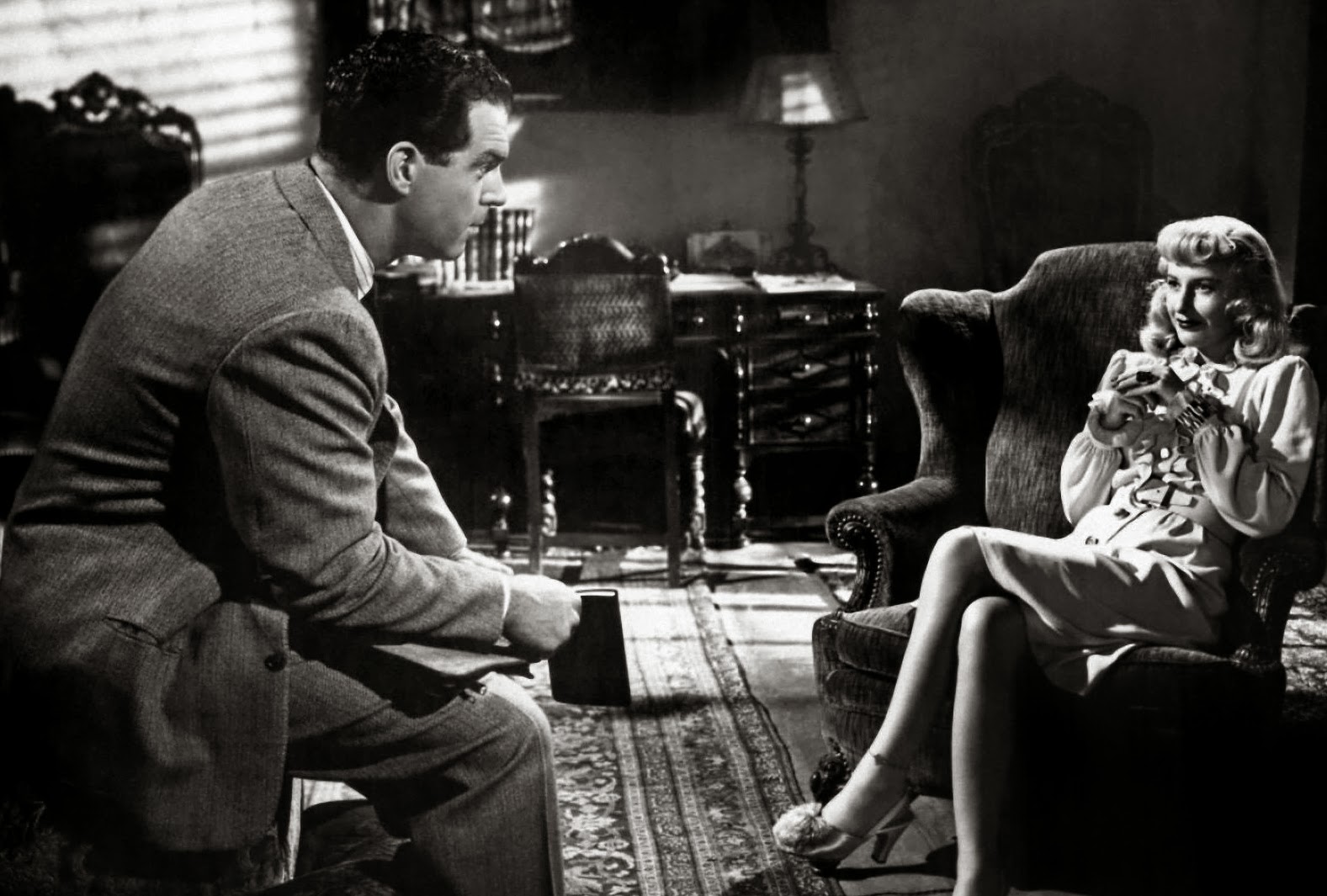
Double Indemnity (1944)

Fred MacMurray plays insurance salesman Walter Neff in this classic film noir from director Billy Wilder (who co-wrote the screenplay with Raymond Chandler, based on the book by James M. Cain). Neff is a good guy. He's a great salesman and also a colleague that claims investigator Barton Keyes (Edward G. Robinson) can depend on. That all changes, however, on the day that he meets Phyllis Dietrichson (Barbara Stanwyck). He's only visiting to get her husband (Tom Powers) to renew his automobile insurance policy, but Phyllis soon starts guiding the conversation towards life insurance and a policy she could get for her husband that would guarantee a big payout if, god forbid, anything ever happened to him.

Highly influential in all the right ways, Double Indemnity holds up today as a great slice of entertainment and a quintessential film noir. It was far from the first movie in that subgenre, but it's one that remains an almost perfect example containing many of the tropes and showing how to perfectly piece them together.

The one MINOR criticism I have is that the dialogue, so cool and great to listen to, quickly becomes a bit too unnatural. Mind you, after listening to an exchange like the entire first meeting between Walter and Phyllis, the many hits are worth the few misses. It's worth noting that, although it seems I am contradicting myself, at least 90% of the script is a joy to tickle and caress the earlobes.

MacMurray and Robinson are superb in their roles, with the former somehow managing to stay sympathetic and likable even as events take a turn for the worse, but this movie belongs to Stanwyck, who grabs her role with both hands and delivers a performance that film-makers have rightly remembered and tried to emulate ever since. There's also a lovely performance from Jean Heather, playing Stanwyck's stepdaughter, never warming to the woman with good reason.

Billy Wilder gave cineastes a number of classics throughout his career. This is one of them. The voiceover narration, the plot twists, the details teased out in the conversations, the performances, the secondary characters who get to make almost as much of an impression as the leads. I almost gave this 10/10, and many will argue that I should have, but that's the joy of us all having different opinions.

9/10

http://www.amazon.co.uk/Film-Noir-Collection-Kirk-Douglas/dp/B000UWXM1C/ref=sr_1_1?s=dvd&ie=UTF8&qid=1383510857&sr=1-1&keywords=film+noir+box+set


Monday, 15 July 2013

Dead Men Don't Wear Plaid (1982)

Steve Martin is detective Rigby Reardon in this amusing, but respectful, slice of fun that makes great use of clips from many classic films of the 1940s (there may be a few movies that come just before or after this decade, but I couldn't say for certain). Reardon has been given a case by the beautiful Juliet Forrest (Rachel Ward), a woman who can sucket a bullet from a gunshot wound, and as he starts to make some headway he soon finds himself in more and more danger. Ain't it always the way.

This black and white outing sees the comedy star teamed up once again with director Carl Reiner, with the pair working on the script with George Gipe, so fans of that relationship will find plenty to enjoy here. There's the usual silliness, but there's also an impressive amount of smart manipulation on display. Every plot development and minor detail is carefully placed onscreen to allow the interaction between Martin and the classic movie characters to seem effortless. The fact that the scenes are often twisted into something comedically brilliant is a big plus, but noir fans may well find themselves falling in love with the "greatest hits" selection of clips put to use.

While there may not be as many moments that stand out as being downright hilarious, Dead Men Don't Wear Plaid still has plenty that will stay in the memory of fans who can then go on to share those gags with other fans. The running gag about Reardon's special cup of java, the reaction from the words "cleaning woman", a number of great lines from the ongoing voiceover narration and more.

The main players all do well, including Reiner, who decided to give himself a small role rather than just stay satisfied with his directing and co-writing duties. Thankfully, the performances from people such as Bette Davis, Burt Lancaster, James Cagney, Cary Grant, Veronica Lake, Ingrid Bergman, Lana Turner and, especially, Humphrey Bogart are all as good as you may remember them being, making the film a pleasure to watch even in between the numerous laughs.

It always feels to me as if Reiner and Martin did many more movies together, but the total was only four. They just happened to be four comedies that either still rank as outright classics, or at least come very close. Don't miss this one, and don't miss any of the others either.

8/10

http://www.amazon.co.uk/Steve-Martin-Collection-DVD/dp/B000QJMSFA/ref=sr_1_1?s=dvd&ie=UTF8&qid=1373746372&sr=1-1&keywords=steve+martin

Sunday, 16 September 2012

Charley And The Angel (1973)

Fred MacMurray takes the lead role in this fairly amusing Disney movie that sees him playing Charley Appleby, a man who is visited by an angel (Harry Morgan) and told that his number is up. This, of course, comes as a surprise to Charley and he immediately starts to worry about getting things in order for his family and trying to make up for lost time. His two young boys treat the father of their neighbouring friend more like their own father, his daughter (Kathleen Cody) is at the age when most of her thoughts revolve around boys (one in the shape of Ed Begley Jr. and one in the shape of Kurt Russell) and his wife (Cloris Leachman) is just used to getting on with things on her own while Charlie works hard and spends his spare time fretting and not being all that much fun. Thankfully, before Charlie has to shuffle off the mortal coil he gets a bit of breathing space, literally, as the angel designated to collect him figures out just why he hasn't died YET and when the exact moment will occur.

Based on the book "The Golden Evenings Of Summer" by Will Stanton (the screenplay was then written by Roswell Rogers) and directed by Vincent McEveety, Charley And The Angel is reminiscent of many other movies about people getting one last chance to change their priorities and put things right in their life. It's also fairly enjoyable after a bit of a lethargic start. In fact, things quickly pick up as soon as Harry Morgan appears and starts having fun in the role of the angel. There's plenty of standard domestic drama but there's also a fun plot strand that sees the two young Appleby boys unwittingly helping some criminals to move large quantities of alcohol.

The cast all do a grand job. MacMurray has given a number of better performances in his career but he's perfectly fine here as the father and husband who is suddenly faced with the realisation of how much he has unwittingly disappointed his loved ones. Cloris Leachman is excellent as the loving wife who starts to worry about her husband's changed personality. Kathleen Cody is bright and bubbly and Begley Jr. and Russell are good enough as the boys vying for her affection. Then we have Harry Morgan, also known as the great Harry Morgan. He's great. I've never seen him be anything less than great but he has a lot of fun here as the playful angel who takes a liking to Charley.

There are others onscreen and they all do well, especially Vincent Van Patten and Scott Kolden as the two youngest Appleby children. The script isn't crammed full of great lines and it's not that sharp but it does enough to keep you interested in the characters and to keep you watching to the very end. Everyone gets a chance to develop nicely after that faltering opening act and there are enough moments of mild amusement to make this worth at least one watch during a rainy afternoon when you have nothing else to hand. Faint praise, I know, but at least it's praise.

6/10

http://www.amazon.com/Charley-Angel-Fred-MacMurray/dp/B005G82GT4/ref=sr_1_1?ie=UTF8&qid=1347648645&sr=8-1&keywords=charley+and+the+angel