Monday, 6 October 2014
Theatre Of Blood (1973)
It all starts with the death of a critic, a single murder that the police investigate with little idea of the motive. When other critics start to die, however, it quickly becomes clear that all of the people have something in common. They all have their own little clique, and they've all greatly upset (to say the least) an actor they thought had died some time ago. But Lionheart isn't dead, and his flair for the theatrical means that those critics are going to help him realise perhaps his greatest repertory season yet.
Directed by Douglas Hickox, Theatre Of Blood benefits enormously from the fun script by Anthony Greville-Bell and the magnificence of such a great ensemble cast. That's not to take anything away from Hickox, who shows such great judgment in the way he treats the material, leading viewers deeper and deeper into territory that becomes surprisingly unpleasant in tone while also making it all just bearable enough to amuse and horrify in equal measure.
Price is the star of the show, and oh how he shines. He gets to recite many famous lines, dress up as a variety of characters, and simply revel in the inspired lunacy of his character in a way that's infectious whenever he appears onscreen. Diana Rigg is lovely and suspicious in the role of his daughter, a woman who resents all those who she thinks drove her father to his death. And Milo O'Shea and Eric Sykes are both enjoyable enough as two of the main police officers trying to stop more brutal murders on their patch. But it's in the casting of the critics that the film gains more bonus points. Michael Hordern, Robert Morley, Arthur Lowe, Coral Browne, Jack Hawkins, Dennis Price, Harry Andrews, Robert Coote and Ian Hendry all prove to be great entertainment, portraying a bunch of smug, nasty critics who don't seem entirely undeserving of their fates. Hendry is the man who pieces everything together, and helps the police to see just what's going on, but everyone gets at least one great scene apiece.
Price considered this film a personal favourite and it's not hard to see why. He always wanted to stretch his wings a bit more, but was so solidly typecast in the prime of his career that it wasn't to be. This film allowed him to stay within the genre that had won him such a loyal army of fans, while also letting him deliver so many great speeches that he would otherwise not had the chance to perform onscreen. It's a win win situation for the star and his fans, making this a film that you won't want to miss.
9/10
This is the disc I recommend purchasing - http://www.amazon.co.uk/Theatre-Blood-Blu-ray-Vincent-Price/dp/B00IJE1QU2/ref=sr_1_1?s=dvd&ie=UTF8&qid=1411828432&sr=1-1&keywords=theatre+of+blood
Sunday, 11 March 2012
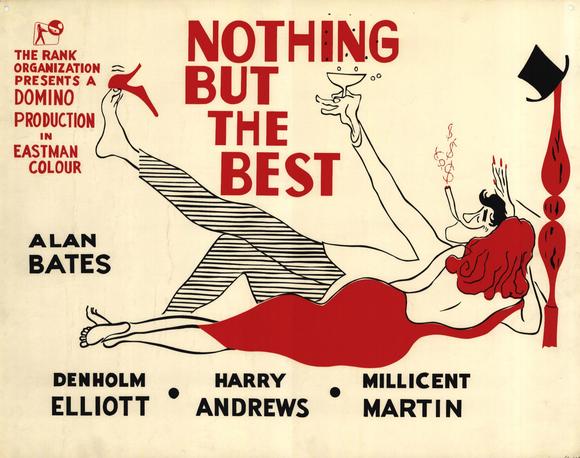
Nothing But The Best (1964)
But there was also a battle to move up the ranks, a struggle for class and status more pronounced than anything that happens nowadays. Oh yes, the rich are now far richer than they ever were and the poor probably far poorer. The divide is certainly greater. But that middle ground, that mixture of people and finances and attitudes, is more turbulent and eclectic than ever before. You can work your way up for years but still, ultimately, find yourself in that middle ground.
Back in the 60s you could work yourself up and find yourself way up high, gazing down at the proles you used to toil alongside. Which is what Jimmy Brewster (Alan Bates) wants to do in this enjoyable, slightly perverse, comedy. To achieve his aim he decides to learn from, and model himself upon, Charles Prince (Denholm Elliott, on wonderful form). Unfortunately, tips and advice can only get you so far towards the next rung. To really make it to the top you need to clear some space by throwing others downward. Lucky for Jimmy that he seems to have the determination to go through with it.
A number of films from this decade are, unsurprisingly, about class and the trappings of any privileged social status. Thankfully, many of them are also very good films with this one being no exception. Nothing But The Best has a fun script by Frederic Raphael, fine direction by Clive Donner and a wonderful cast that starts off well with Bates and Elliott in the lead roles and then gets better and better with the performances from Harry Andrews, Millicent Martin, Pauline Delaney, James Villiers and everyone else involved.
Add many little details that make viewing a pleasure, plus cinematography by Nicolas Roeg, and you have a delightful black comedy that deserves to be given an airing occasionally (either on TV or, even better, on DVD) and to find an appreciative audience.
8/10.
http://www.vicpine.co.uk/Nothing-But-The-Best.htm
Saturday, 7 January 2012
The Jokers (1967)
Before he settled into a disheartening routine of recycling his own material, playing around with celebrity chums and judging various meals, Michael Winner was a director with no small amount of wit and talent. Yes, I said it. It's largely forgotten nowadays but look back through his filmography and there are still a number of his movies that are worth seeking out. The Jokers is one of them.
The relatively slim plot sees Michael Crawford and Oliver Reed playing two brothers who enjoy nothing more than a good prank or two, the more audacious the better. Between them, they hatch the ultimate caper: they're going to steal the Crown Jewels. As long as they make it clear that they never intended to keep them for personal gain then they should be able to get away with the whole thing. Well, that's the plan.
It's a movie from the late 60s set in London so you shouldn't be surprised to find more than one or two scenes that focus on the groovy side of life and just how cool everyone is, whether they're dancing in a disinterested fashion or watching a piece of performance art (performed and viewed, it has to be said, in a slightly disinterested fashion). Because being disinterested = being cool. You dig? The characters played by Crawford and Reed are the coolest of the cool because they aren't actually interested in anything around them that doesn't serve to amuse them or be manipulated in their numerous schemes. And while I may seem to be sarcastic here, I assure you that it's only slight sarcasm. Swinging 60s London is a scene that can provide a lot of unintentional giggles but, dammit, it does still seem very cool. And Crawford and Reed ARE cool in this film, the former really embodying the kind of laid-back, carefree cad audiences should actually hate (but don't) and the latter being simply Oliver bloody Reed in, arguably, the prime of his life.
A great supporting cast features a number of faces familiar to classic movie fans and/or UK TV viewers: Harry Andrews, James Donald, Daniel Massey, Brian Wilde, Edward Fox, Michael Hordern, Peter Graves, Warren Mitchell, Frank Finlay and many more.
The script is written by two other names familiar to fans of UK TV - Dick Clement and Ian La Frenais, a writing team responsible for classic shows such as "The Likely Lads" and the absolutely superb "Porridge". The story idea may have been hatched by director Winner but the two men make sure that things zip along nicely in between the key moments and that every line is in character, and usually pretty funny when juxtaposed alongside the attitudes of the characters onscreen.
Michael Winner deserves some praise. Sometimes. The Jokers may not be an absolutely unmissable classic but it holds up well. Much like The Thomas Crown Affair, it's a heist movie that takes more delight in enjoying the boredom of the bourgeoisie and how those afflicted may try to cure themselves. A fun film worth checking out.
7/10
If you have enjoyed this, or any other, review on the blog then do
consider the following ways to show your appreciation. A
subscription/follow costs nothing.
It also costs nothing to like/subscribe to the YouTube channel attached to the podcast I am part of - https://www.youtube.com/channel/UCErkxBO0xds5qd_rhjFgDmA
Or you may have a couple of quid to throw at me, in Ko-fi form - https://ko-fi.com/kevinmatthews