Showing posts with label edward berger. Show all posts

Sunday, 2 November 2025

Netflix And Chill: Ballad Of A Small Player (2025)

I don't want to be rude about Colin Farrell, someone I have loved onscreen more and more with every step he moved away from typical blockbuster lead roles, but I am more impressed with his role in Ballad Of A Small Player for his ability to portray what, at times, would seem to be a past incarnation of himself. Farrell has been sober for many years now, and massive congratulations to him for that, but he's been very open about the many wild nights in his past. I wondered if he was experiencing déjà vu here whenever his character would wake up groggy and anxious after some time spent spending too much money and drinking too much alcohol. I mention this not just because of the behaviour displayed onscreen. It's the tone. Ballad Of A Small Player is all about a man who believes that one lucky break is just around the corner, yet also knows that he is being driven by desperate addictive impulses that could just as easily lead to him dying before he gets the chance to see any uptick in his fortunes.

Farrell is Lord Doyle, if we're to believe how he presents himself. He's a gambler who enjoys placing large bets and living the high life. He's had a recent run of bad luck though, which forces those around him to place a timeline on some debts. Doyle encounters kindness and generosity from Dao Ming (Fala Chen), but he has to make a decision on whether to accept her help to move away from his life of gambling or to make use of her kindness to facilitate his path to that one big win he can sense heading his way. It doesn't help that he's also being watched by Blithe (Tilda Swinton), someone who has been tasked with tracking him down and reclaiming some major past debt.

Adapted into screenplay form from Lawrence Osborne's novel by Rowan Joffe, Ballad Of A Small Player actually has a lot in common with one or two other gambling films I could mention, but just mentioning those might allow you to start predicting how things will end for the main character. So I'm not going to do that. There's a whole lot of anxiety running throughout the film, and even any unexpected victories in the casinos feel fragile and temporary, considering the nature of the main character. 

Director Edward Berger is three for three when it comes to the features that he's helmed over the past five years, and I'm keen to see if he can keep up this hot streak to put himself in contention for the director with the most consistently superb output throughout this decade. While it's ultimately a slightly lesser film than his previous two outings, being an inessential character piece, as opposed to a rumination on the hell of war or a murder mystery aiming to shake the pillars of Catholicism, Berger treats it with no less care. This is grandiose, operatic even, and every viewer is masterfully taken through a variety of ups and downs as if attached by a safety wire to some member of Cirque du Soleil.

Despite the occasional (apparent) lapse in his upper-class British accent, and nothing here is without an explanation, Farrell is superb in the lead role, all flop-sweat and faux-graciousness as he keeps looking around his environment for various escape routes and gambling opportunities. He's the star, and his charisma is put to great use throughout. It's impressive that Chen makes such a strong impression, considering how often she has to share the screen with Farrell while she's the calming presence to his manic aura. Swinton gives one of her fine supporting turns, and is especially delightful in the third act, and both Deanie Ip and Alex Jennings are worth mentioning as individuals who may succeed in tempting Farrell's character to make the one bet that finally destroys him.

I enjoyed this, I was stressed out by it, and I am conflicted by the ending, which is actually a better outcome than the one I expected. It's a small-scale and low-key film that feels huge and bombastic. It taps into that rollercoaster of highs and lows that I am sure every gambler knows is the rhythm of their life, for better or worse.

8/10

If you have enjoyed this, or any other, review on the blog then do consider the following ways to show your appreciation. A subscription/follow costs nothing.
It also costs nothing to like/subscribe to the YouTube channel attached to the podcast I am part of - https://www.youtube.com/channel/UCErkxBO0xds5qd_rhjFgDmA
Or you may have a couple of quid to throw at me, in Ko-fi form - https://ko-fi.com/kevinmatthews
Or Amazon is nice at this time of year - https://www.amazon.co.uk/hz/wishlist/ls/Y1ZUCB13HLJD?ref_=wl_share 

Friday, 31 January 2025

Conclave (2024)

I never thought that I would rate a movie all about religious figures trying to form a majority vote for the new pope as highly as I have rated Conclave. I don't care for religious institutions, especially not the greedy and notably-prone-to-moral-corruption Roman Catholic Church. I view that particular entity as an appalling blight on the modern world, considering the wealth it has amassed over the years and the abuses that it has covered up. So, before I started hearing good word on this, I initially thought that I would much prefer to watch The Pope Must Die.

Based on a book by the excellent Robert Harris, this is a surprisingly gripping and intense drama that makes great use of a very talented cast, all helped by Peter Straughan's superb screenplay (and a quick look through his filmography shows him to be, while far from infallible, a writer with a selection of features well worth your attention). Playing out like a legal drama, it also manages to comment on the image of the church, and what can be done to improve relations between those who want to best serve their god and the public who may no longer have trust in them.

Ralph Fiennes is Cardinal Lawrence, a man who ends up leading a sombre and vital voting session when the Pope dies of a heart attack. A new successor must be found, and they have to be in a good position to lead the church forward in the modern world. Top contenders are Cardinal Bellini (Stanley Tucci), a liberal choice, Cardinal Tremblay (John Lithgow), a moderate choice, Cardinal Adeyemi (Lucian Msamati), and Cardinal Tedesco (Sergio Castellitto). There's also a surprise addition in the shape of Cardinal Benitez (Carlos Diehz), someone the Pope seemed to favour, although nobody in attendance was previously aware of his existence.

While it would be almost impossible for director Edward Berger to surpass, or even equal, his previous film, he has at least managed to show that he's a consistently interesting and formidable talent. There's no world war onscreen this time, but we still get a number of important skirmishes between opposing factions. Making great use of some twists and reveals to help the pacing, as well as a sense of the outside world heating up in a way that reminds all of those present of just how important the church figurehead is, Berger allows the talented cast to enjoy Straughan's dialogue without needing to add too many bells and whistles to every scene. There's enough to keep viewers hooked in the performances and the small details of the process.

Fiennes is quite flawless in his lead role, a potentially one-note character turned into a well-rounded and fascinating heart hoping to keep life pumping through the veins of a body in serious need of the right medical treatment. Tucci is equal to him, all the more enjoyable for showing some of the frustration that Fiennes seems to somehow keep harnessed deep within himself. Lithgow livens things up a bit, and has a bit of fun with the development of his character, and Msamati, Castellitto, and Diehz all do well just to share the screen with some of the bigger names. Isabella Rossellini seems to be a bit unnecessary, but only until she isn't, and I'm glad there was room for even the smallest of female roles in this male-dominated space, and Brían F. O'Byrne does great work as the assistant to our leading man.

Quiet and contemplative for most of the runtime, but also punctuated by moments of blustery anger, Conclave is a confident and beautiful chamber piece. There's lovely music from Volker Bertelmann and beautiful cinematography by Stéphane Fontaine, but the whole thing really boils down to a talented cast making the most of a smart and interesting script. Some viewers may not appreciate the very last scenes, but I think it all felt like a wonderful way to illustrate the huge chasm that currently exists between the old ways of the church and the new world all around us. Highly recommended, as long as you know that you're going to be watching a film based around a group of men voting on who will be the next Pope.

8/10

If you have enjoyed this, or any other, review on the blog then do consider the following ways to show your appreciation. A subscription/follow costs nothing, and ALL of the links you need are here - https://linktr.ee/raidersofthepodcast
Or you may have a couple of quid to throw at me, in Ko-fi form - https://ko-fi.com/kevinmatthews
Or Amazon is nice at this time of year - https://www.amazon.co.uk/hz/wishlist/ls/Y1ZUCB13HLJD?ref_=wl_share

Sunday, 5 March 2023

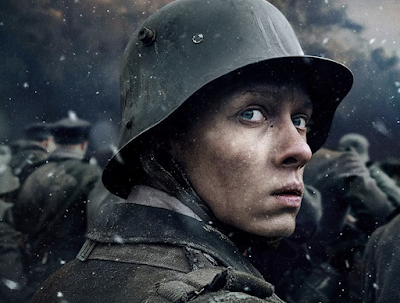
Netflix And Chill: All Quiet On The Western Front (2022)

I often get in trouble for my stance on military life, and the automatic respect afforded to those in uniform who are enforcing the will of politicians and rich businessmen (soldiers and police, mainly). I do respect individuals who have made efforts to do their best for others in a role that sometimes asks them to forget that they are encountering other humans in their main interactions, but it's not automatically given. Just look at the state of the world right now - note, for future reference, we're currently just over a year on from Russia invading Ukraine and having us all worried that it will end with an act of absolute lunacy - and think of how different it would be if the bravest soldiers refused to act automatically on orders given to them. That might hurry things along to the use of long-range, even nuclear, weaponry, you might think. Yes, but think of how much braver someone needs to be to refuse a dictatorial maniac who wants someone helping him to launch missiles. I believe they would know that it would mean the end of their life, and every subsequent next person in line would need to be even braver, but doing the right thing is rarely the same as taking the easy option. 

We see the best that soldiers can do when they help deliver emergency aid, when they present themselves as examples of the best and kindest kind of patriots. We don't see the best of them when they're in battle, particularly when that battle is due to the greed of one or two madmen who want to move borders and swallow up the assets of those they can overcome. Films have always struggled to show this, the dehumanisation of men that turns them into more effective fighting soldiers and the insanity and horror of throwing those who have barely reached adulthood into a mincer, meat to be slopped into the blood-soaked and hazy hellscape of a battlefield. Some have worked better than others, but it's almost impossible to make a war tale both cinematic and suitably condemnatory of the whole situation.

All Quiet On The Western Front (based on the novel by Erich Maria Remarque, and filmed a number of times before, although I have sadly neither read the source material or seen any other film version yet) gives it a better go than most. I was halfway through this 148-minute movie when I wondered if I could make it to the end. Not that the pace was dragging, nor was it weak in any department. I was finding it too difficult to watch. The constant mounting of horrors that couldn't be escaped, the cacophony of weaponry, the excruciating pain of the deaths (whether in the sheer volume or the individual moments showing how long it can take). It was all becoming unbearable, despite clearly being nowhere close to the experience of actually being a soldier put into those situations. In terms of reminding you of what it must take to be in the midst of battle, few films, if any, come close to making the same impact as All Quiet On The Western Front. And, yes, that includes the best war films you are already thinking of right now.

Viewers follow the journey of Paul (Felix Kammerer) as he signs up for an active role in the military, faking a signature to pretend that he has the permission of his parents. There are one or two moments of good cheer and camaraderie, and then the reality starts to sink in. Other characters come and go, and you might already suspect why that is, but Paul goes through a wide variety of wartime experiences: battling a physical enemy, battling hunger, and battling to hold on to his nerve as he has to force himself through one trauma after another.

Director Edward Berger, who also wrote the superb script with Lesley Paterson and Ian Stokell, has delivered something here that I think might be as timely as it is flawless. It is not only deserving of all the praise it has been getting, it's worth more. This is another very strong contender for the best film of 2022, which means I have to slightly rearrange my list AGAIN, and I fear that I would just be searching for unnecessary adjectives trying to heap all of my praise upon it.

The script is structured well to show some main characters, to underline relevant moments, and to move between the fighting and the politics (Daniel Brühl playing the main character trying to negotiate peace with the French, realising that the German death toll makes the ongoing situation unsustainable). The camerawork and effects throughout are astonishing, putting viewers in the midst of the action without becoming too disorientating, or feeling too focused on the technical trickery of the shots and onscreen content. And the music by Volker Bertelmann . . . well, it's very possibly my favourite movie score from the past few years. Stunning stuff.

Kammerer is a great lead, especially for the jarring effect of his youthful appearance juxtaposed against what is being asked of him, but nobody in the cast does a bad job. I'll namecheck Albrecht Shuch, Aaron Hilmer, Moritz Klaus, Adrian Grünewald, Edin Hasanovic, and Brühl, but an effective depiction of wartime needs hundreds of people to show the soldiers being fed through the war machine, and this has a very lengthy cast list that I wish I could just copy and paste here. 

War is hell. War is madness. War is used as the solution to problems that don't exist before madmen create them. And it's worrying that so many people keep forgetting the lessons that are right there in our history, not even ancient history. So it looks as if war is a mistake we are doomed to repeat for a long time to come, or until someone does the unthinkable. Before that happens, and apologies for not ending on a cheerier note, everyone should make time to watch All Quiet On The Western Front

10/10

If you have enjoyed this, or any other, review on the blog then do consider the following ways to show your appreciation. A subscription/follow costs nothing.
It also costs nothing to like/subscribe to the YouTube channel attached to the podcast I am part of - https://www.youtube.com/channel/UCErkxBO0xds5qd_rhjFgDmA
Or you may have a couple of quid to throw at me, in Ko-fi form - https://ko-fi.com/kevinmatthews