Showing posts with label noémie merlant. Show all posts

Monday, 13 November 2023

Mubi Monday: The Innocent (2022)

Co-written and directed by Louis Garrel, who also gives himself a plum lead role once again, The Innocent is an entertaining thriller that, on the one hand, plays out exactly as you might expect, yet also wrongfoots you slightly by the time the end credits roll, thanks in part to the title itself, and who it might be referring to.

Garrel plays Abel, the concerned son of Sylvia (Anouk Grinberg). He may be right to be concerned, as his mother has a habit of falling in love with, and marrying, people that she meets at her work. And she works in a prison. Her latest husband is Michel (Roschdy Zem), and Abel doesn’t trust him to stay on the straight and narrow. He wants to find out more about his plans, and enlists the help of Clémence (Noémie Merlant). It isn’t long until everyone starts to tangle themselves up in lies and deceit. Well . . . almost everyone.

Having only seen one other Garrel movie before this (the underwhelming Two Friends), and seeing the plot summary of this, I have to admit that I wasn’t really expecting too much from The Innocent. I assumed it would be a tired retread of very familiar ground, and wondered if Garrel might spoil his own direction by focusing too much on his own acting. Well, assumption makes an ass out of you and me, or something like that, and I am very happy to say that I was proven wrong here.

Paced perfectly (the runtime clocks in at just under 100 minutes), and with characters that it’s easy to warm to, despite them perhaps initially appearing too sharp and antagonistic, or too untrustworthy, the script allows for a nice and even mix of plot development and great character moments. Writers Tanguy Viel and Naïla Guiguet both work well with Garrel, with Guiguet having previously collaborated with the writer-director on his previous movie, The Crusade, and there’s a playfulness underpinning the interactions of the main characters that helps to avoid a cynicism and bleakness that would have left the whole thing feeling much more in line with so many other movies in this sub-genre.

When it comes to the performances, everyone is perfectly cast. Garrel continues his run of portraying characters named Abel (it must be some strange in-joke or personal preference, he has given himself that name in all of his features so far), Zem manages to feel both charming and potentially dangerous, Merlant helps to brighten up the film as she treats things quite lightly until they take a turn for the serious, and Grinberg is a sweetly optimistic romantic who just wants everyone to get along and be happy that she is happy.

Although it doesn’t reinvent the wheel, The Innocent manages to feel enjoyably unique without overdoing the quirkiness (even if the opening scenes may make you think it is heading in that direction). It’s consistently great, and the finale feels as inevitable as it is satisfying. I recommend it to anyone after some crime movie thrills without the need for a large sprinkling of misanthropy.

8/10

If you have enjoyed this, or any other, review on the blog then do consider the following ways to show your appreciation. A subscription/follow costs nothing.
It also costs nothing to like/subscribe to the YouTube channel attached to the podcast I am part of - https://www.youtube.com/channel/UCErkxBO0xds5qd_rhjFgDmA
Or you may have a couple of quid to throw at me, in Ko-fi form - https://ko-fi.com/kevinmatthews
Or Amazon is nice at this time of year - https://www.amazon.co.uk/hz/wishlist/ls/Y1ZUCB13HLJD?ref_=wl_share

Friday, 13 January 2023

Tár (2022)

Written and directed by Todd Field, with the main role specifically earmarked for Cate Blanchett, Tár is a character study and a murky psychological thriller that claims to be making a statement about abuse and manipulation, but seems to sadly muddy the waters of a conversation that still doesn’t seem to be allowed to fully unfold without numerous caveats and attempts to put a different angle on things. I will get back to this point later, but please bear it in mind.

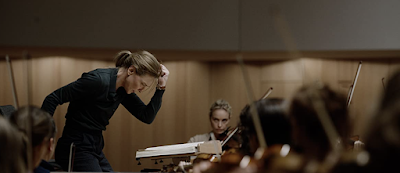
Blanchett plays Lydia Tár, a phenomenal musician and composer who is aiming to present a symphony she believes may well be her greatest triumph. Lydia has a loyal assistant (played by Noémie Merlant), a supportive wife (played by the incredible Nina Hoss), and numerous students and peers all ready to bask in the glow of her talent and heap more praise upon her. She also has a history of manipulation and exploitation of her position, whether it is intentional or not. The death of a former student, and the circumstances surrounding her relationship with Lydia, leads to the start of a whirlwind change of events that may see the maestro feeling more in the pits than on the podium.

There’s no denying that this is an interesting film, paced slowly to draw viewers into the world of the main character, and featuring a superb core cast all doing great work. I would argue that both Blanchett and Hoss are two of the best actresses working today, and they are joined onscreen by the talented Mark Strong, Julian Glover, and others I am less familiar with, but who were certainly bringing their A-game while orbiting such a flawless lead performance. Because Blanchett, whether conducting an orchestra, playing piano, or shredding apart a student for letting their modern day morality affect their choice of music to work with, IS flawless here. She can do cold and calculating as well as she can do confused and flustered, and she seems to relish playing someone we get to see, at one point, menacingly threaten a child.

Field knows what he is doing, constantly framing the film around Blanchett’s imposing figure, with most of the scenes showing passionate and dedicated musicians doing their work in displeasingly dark and cold environments, unless relishing the times when playing to an audience. There is an ugliness here, from the visual palette to the light levels, but it feels like a reflection of the world that Lydia has created for herself, one that is only lit up by a few different elements.

Getting back to the conversation this is part of though, Tár would seem to be a film originating from the #metoo movement, making it another important part of an ongoing process that hopes to make our world safer and more transparent for women (not exclusively women, but predominantly so), but that is where it feels least valuable. This feels, to me, like a “not all men” movie, but the phrase has been contorted into the equally-redundant “see, women do it too”, which doesn’t really feel as helpful, in the grand scheme of things, as something that could have been more complex, more subtle, and ultimately more effective, which I feel is owed to any viewer affected by the issues at the heart of the film.

I guess, rightly or wrongly, I viewed this with a raised eyebrow because it is a story I feel should have been left at the back of a queue for a while. I don’t think we have had enough films properly showcasing other scenarios yet, whether it is more powerful men being held to account or other common victims having their voices heard (the statistics regarding assault and abuse of trans people, for example, always seem to be omitted from this bleak landscape).

Tár has one towering performance, and sterling work from others onscreen, but it doesn’t actually have enough beneath the surface to make you feel that it is worth 2 1/2 hours of your time. I would still recommend it, and think Blanchett will continue to receive a lot of well-deserved credit for her portrayal of such a sharp and “jagged” character, but it’s not actually a great film.

6/10

If you have enjoyed this, or any other, review on the blog then do consider the following ways to show your appreciation. A subscription/follow costs nothing.
It also costs nothing to like/subscribe to the YouTube channel attached to the podcast I am part of - https://www.youtube.com/channel/UCErkxBO0xds5qd_rhjFgDmA
Or you may have a couple of quid to throw at me, in Ko-fi form - https://ko-fi.com/kevinmatthews

Monday, 13 April 2020

Mubi Monday: Portrait Of A Lady On Fire (2019)

I approached Portrait Of A Lady On Fire with no small amount of trepidation. Nothing to do with what could or couldn't be in the film (I actually had no idea), but more to do with the overwhelming praise it had already received from all corners. That sometimes sets you up for a disaster. What if you like it, but don't love it? What if you don't like it? Everyone should form their own opinions about art, but when your opinion is contrary to that of almost everyone else it can lead to some creeping insecurity about your own perception and filters.

I can breathe a sigh of relief now, because Portrait Of A Lady On Fire is very good indeed. Phew. I might still get into some interesting conversations, however, as I couldn't see how it garnered QUITE the level of praise that has been heaped upon it.

Written and directed by Céline Sciamma (I have previously enjoyed Tomboy, although others have found that one a bit problematic), the film tells the story of a young painter (Marianne, played by Noémie Merlant) tasked with painting the portrait of a young woman (Héloïse, played by Adèle Haenel) who is due to be married to a gentleman from Milan. Héloïse has previously refused to be painted, she really isn't keen on the marriage that has been arranged for her, something set up rather hastily after the death of her older sister, and that means Marianne has to observe her subject more closely, pretending to be a companion as she observes everything that she hopes she can then use to create the portrait. She is helped in her scheme by Sophie (Luàna Bajrami), a young maid who seems happy to help, especially as the artist and unwitting subject spend more time together and form a stronger connection.

There's certainly plenty to enjoy here, with the lead performances being right at the top of that list. Both Merlant (destined to be played by Emma Watson in any English-language remake, surely) and Haenel doing superb work with a script that conveys more with the silent moments than it does with the actual dialogue. Bajrami is equally good, and her small role is expanded for a couple of important and interesting scenes, and I was pleased to recognise Valeria Golino in a strong supporting role, playing the Countess/mother of Héloïse.

Sciamma has a great eye, composing many of the scenes in a way fitting for a film about an artist striving to create a piece that would become her most important work. A recurring vision is particularly striking, and shown again towards the end in a context that shows how things were being foreshadowed, and the film often feels as if it is made up of firelight and shadows (one of the main posters even takes a frame from one specific moment that does this best).

Thematically, this is surprisingly simple stuff. The other things that are mixed into the plot (appreciation of great art, the sub-plot involving the maid) easily fade into the background when the focus returns to the central relationship between Marianne and Héloïse, and the love that blossoms between them. Which again puts most of the success of the film on the shoulders of the leads.

Beautifully shot and put together, perfectly cast, and fairly flawless throughout, Portrait Of A Lady On Fire deserves your time and attention. The only thing going against it is the fact that it feels a bit too much like a trip through well-trod territory for most of the runtime.

8/10