Showing posts with label val lewton. Show all posts

Friday, 23 September 2022

The Seventh Victim (1943)

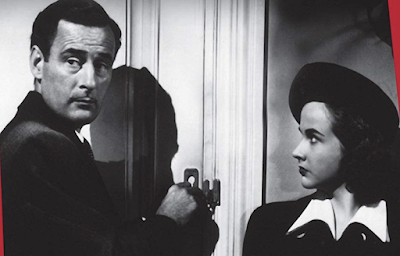
The directorial feature debut of Mark Robson, and the continuation of his working relationship with producer Val Lewton, The Seventh Victim is an odd mix of drama and what I couldn’t help viewing as very dark, and twisted, humour.

The plot focuses on Mary Gibson (Kim Hunter), a young woman who begins her own investigation when she is informed that her sister (Jacqueline, played by Jean Brooks) has gone missing. It isn’t long until Mary meets a few people who may be able to help her in her quest, including a psychiatrist (played by Tom Conway), a poet (Erford Gage), and a husband (Hugh Beaumont) she was previously unaware of. But where is her sister, and what has happened to her?

Like some other movies I have watched recently, The Seventh Victim is best appreciated by people who don’t bring their own expectations to it. The title may suggest a crime thriller (perhaps a serial killer movie) or something supernatural, but what you actually get is a framework that allows some time to be spent examining the power of faith, despite it being in a rather unusual context. This isn’t an unfamiliar topic to Lewton, of course, and you could argue that most of the movies he produced had that at the heart of them, but it’s a slightly less comfortable fit here, although everything still works well enough.

The script, by Charles O’Neal and DeWitt Bodeen, manages to take viewers through an ever-darkening corridor with enough light touches and breathing space to distract from the gloom and doom until reaching a rather bleak final destination. It’s just a shame that the ending isn’t at all satisfying, and the final scene feels more like a punchline than something effectively poignant.

Although Hunter, Conway, Gage, and Beaumont all do well in their roles, they also often feel as if they are starting in a different movie from the one in which a woman has gone missing, and is presumably in danger. Remove a couple of main scenes and you end up with a standard rom-com narrative here. Brooks, on the other hand, benefits from being the endangered woman, with her intermittent appearances creating either more mystery or more danger.

While not a bad film, this is easily the worst of the films I have seen produced by Lewton. It suffers from an identity crisis, as well as some plotting that never feels as tight and well-handled as it should be (especially when you consider the lean 71-minute runtime). I didn’t mind watching it, but I doubt I will ever want to rewatch it.

6/10

If you have enjoyed this, or any other, review on the blog then do consider the following ways to show your appreciation. A subscription/follow costs nothing.
It also costs nothing to like/subscribe to the YouTube channel attached to the podcast I am part of - https://www.youtube.com/channel/UCErkxBO0xds5qd_rhjFgDmA
Or you may have a couple of quid to throw at me, in Ko-fi form - https://ko-fi.com/kevinmatthews
Friday, 16 September 2022

Bedlam (1946)

Directed by Mark Robson, who co-wrote the screenplay with Val Lewton, Bedlam is a wonderfully dark and nasty piece of work. I don't know what people would have thought of it when it was first released, but I can understand it not finding an audience immediately. While tame in many respects nowadays, it somehow retains an impressive power, thanks in no small part to the sterling central performance from Boris Karloff.

Karloff plays Master George Sims, the man in charge of an insane asylum (there are many better ways to word that, granted, but I think bluntness here matches the tone of the film). Sims keeps himself in the good graces of Lord Mortimer (Billy House) by occasionally using the patients in his care to put on a distasteful show. Sims is used to doing what he wants, and he makes extra money by charging people to enter the asylum and look around, but he starts to come unstuck when his ways are questioned by Nell Bowen (Anna Lee). Nell is a companion to Mortimer, which means she may have the ability to convince him of how badly the asylum is run, and Sims has to think and act quickly. Nell won't be much of a threat to him if she ends up IN the asylum.

A sadly familiar tale nowadays, we have had many films showing authority figures abusing their position of power, Bedlam remains a prime example of this kind of film. It also remains a twisted and vicious piece of work, as well as a damning indictment of the way society tends to deal with the mentally ill. Things have greatly improved over the years, thankfully, but there are also ways in which people continue to be misdiagnosed, mistreated, and stigmatized.

Despite stiff competition, Karloff delivers a performance that could easily be considered among his very best. There’s no soft centre this time around. The monster is all monster here, and Karloff portrays every bit of merciless scheming without feeling the need to wink or reassure viewers. He is thoroughly unlikable in a way that keeps you riveted, and the fact that Lee does such a great job in her role as the “woman who won’t stay quiet” is testament to her performance. With a number of enjoyable supporting turns dotted throughout, a good dollop of praise should be heaped upon whoever was responsible for casting, and the consistency of quality means I would once again rather direct people to browse the entire cast list than try to single out any one other performance.

Robson and Lewton do everything that they set out to do, using their central premise to link together a number of dark and unforgettable grotesqueries. They know how to make the most of their assets (mainly Karloff and Lee) and they have confidence in their own abilities. That confidence is not misplaced, and I can happily recommend this to anyone who has already appreciated some of the other films featuring people who worked on this, whether behind or in front of the camera.

8/10

If you have enjoyed this, or any other, review on the blog then do consider the following ways to show your appreciation. A subscription/follow costs nothing.
It also costs nothing to like/subscribe to the YouTube channel attached to the podcast I am part of - https://www.youtube.com/channel/UCErkxBO0xds5qd_rhjFgDmA
Or you may have a couple of quid to throw at me, in Ko-fi form - https://ko-fi.com/kevinmatthews

Thursday, 8 September 2022

The Curse Of The Cat People (1944)

The toughest of the Val Lewton-produced films to discuss, and review, The Curse Of The Cat People is arguably a more difficult film to appreciate BECAUSE of the title, and because it is plotted as a sequel to Cat People. Lewton was used to titles being foisted upon him, it was the method used for a lot of his output while at RKO, and a method that allowed him to turn many obstacles into opportunities, but it feels to me as if The Curse Of The Cat People just cannot quite deliver a film able to carry the weight of that title.

Kent Smith and Jane Randolph return, playing Oliver and Alice Reed, and their family unit is completed by young Amy Reed (Ann Carter).  Amy is your typical little girl, although she may have an atypical imaginary friend, in the shape of her father's first wife (Irena, played by Simone Simon). Other characters who become part of this story are Barbara Farren (Elizabeth Russell) and her mother Mrs. Julia Farren (Julia Dean), as well as one of Amy's teachers, Miss Callahan (Eve March), and what unfolds is a look at the power of a child's imagination and the importance of allowing children to enjoy what their imagination creates for them.

Directed by Robert Wise, who took over from director Gunther von Fritsch, and written by DeWitt Bodeen, this is a lovely exploration of the themes just mentioned above. People expecting the kind of chills delivered by the first film will be (rightly?) disappointed, however, because what you get is part family drama and part fairytale. There’s a hazy, dream-like, atmosphere for most of the runtime, almost a physical fog overlaid on the film, perhaps as if viewers are being asked to peer as far back into their own past as possible.

The acting is decent enough from everyone, but it’s also all in relation to how people deal with young Amy. Carter is enjoyably believable in that role, and ready to approach others with an innocent and unguarded attitude. She will befriend anyone, and may not always differentiate between what is real and what is her imagination. Smith and Randolph have to just be the loving parents, basically, which they do well enough, and Simon gets to appear in what feels like a pleasing cameo. Russell and Dean both get a bit more to work with, and Russell makes the strongest impression due to her dislike of a child she sees getting more affection and attention from her mother than she does, and March is likable, but the film never spends much time looking at things from the POV of the adults. This is all about the child, and it is a relief that Carter is able to deliver the performance that the film deserves.

Although the set-pieces are small in scale, low-key in how they play out, they are interspersed throughout the 70-minute runtime in just the right places to help the pacing. And they work well. They will feel familiar to anyone who can remember their own childhood, and there’s a nice juxtaposition between the adult concerns and the small moments that seem overwhelming to a child.

Anyone who has read this review and doesn’t seem sure about whether or not they need to watch this . . . you do. Despite me starting this review with a warning about the baggage attached to it, and the difficulty of appreciating it for what it is (as opposed to what people may expected from it), It at least properly links to Cat People, there’s a very small role for Sir Lancelot (a Lewton regular at this time), and the finale manages to add some unexpected tension and dread. It is a very good film. It just isn’t as good as the film it follows on from.

8/10

If you have enjoyed this, or any other, review on the blog then do consider the following ways to show your appreciation. A subscription/follow costs nothing.
It also costs nothing to like/subscribe to the YouTube channel attached to the podcast I am part of - https://www.youtube.com/channel/UCErkxBO0xds5qd_rhjFgDmA
Or you may have a couple of quid to throw at me, in Ko-fi form - https://ko-fi.com/kevinmatthews

Thursday, 1 September 2022

Isle Of The Dead (1945)

Although I have watched a number of the Val Lewton-produced films of the 1940s by now, I decided to review this one not so long after I Walked With A Zombie because it feels, in many ways, as if it covers familiar ground. It's overflowing with the usual atmosphere, of course, but at the heart of it is an examination of characters who disagree over the power of faith, with one particular individual seemingly happy to do make themselves look bad if it benefits the greater good.

Boris Karloff is General Nikolas Pherides, a man who visits the "Isle Of The Dead" to pay respects to his dead wife. He is accompanied by a reporter (Oliver Davis, played by Marc Cramer). Discovering the grave site has been disturbed, Pherides and Davis eventually wander through different parts of the island, ending up at the household of Dr. Aubrecht (Jason Robards Sr.), who also has the company of his housemaid (Madame Kyra, played by Helen Thimig), a visitor named St. Aubyn (Alan Napier), his poorly wife (Mary St. Aubyn, played by Katherine Emery), and their young companion, Thea (Ellen Drew). There are one or two others also packed into this one household, but these names make up the main group. Unfortunately, all end up quarantined when one of the guests dies from what a doctor diagnoses as the plague. Can everyone hold out, stay safe, and wait for quarantine to be over? Or will they remain in danger until they get rid of the vorvolaka (a malevolent demon in human form) in their midst? Most people don't believe in the vorvolaka, but Madame Kyra does, and she intimates to Pherides that she suspects Thea.

Written mainly by the talented Ardel Wray, Isle Of The Dead is a character study, an examination of the hold that folklore can have over some people, and essentially a battle between faith and science. The scenario allows neither side an obvious path to victory, but that does nothing to dim the belief of anyone hoping against all hope that they will be helped by the system they support.

Director Mark Robson has everything he needs to help make this a cracking little yarn. The script is solid, and has one or two genuinely creepy moments amidst the plague drama, the production design and set dressing is superb (allowing the locations to feel 100% real throughout), and there’s an absolutely fantastic performance from Karloff at the heart of it, a man who can steel himself to do what others would find unpalatable, to say the least.

Although there is ample screentime for both Cramer and Drew, the younger members of the group who end up trapped and in danger, and you also have some scene-stealing from Thimig and Emery, the two women causing tension in very different ways, this is a film that belongs to Karloff. When he is onscreen he is magnificent, but he also casts a lengthy shadow that slows you to feel his presence for many moments that don’t have him front and centre.

Clocking in at about 70 minutes, this is another lean chiller that does everything it wants to do, setting things up quickly and then allowing for a really interesting middle section before the resolution starts to play out. Although not mentioned half as often as some other great titles from this time, Isle Of The Dead deserves a hefty serving of praise and recognition. It’s a fantastic little film, and I hope others find it, or (for those who found it way before I did and are currently rolling their eyes at my standard tardiness) I hope people keep recommending it alongside the more commonly-mentioned titles in this category.

8/10

If you have enjoyed this, or any other, review on the blog then do consider the following ways to show your appreciation. A subscription/follow costs nothing.
It also costs nothing to like/subscribe to the YouTube channel attached to the podcast I am part of - https://www.youtube.com/channel/UCErkxBO0xds5qd_rhjFgDmA
Or you may have a couple of quid to throw at me, in Ko-fi form - https://ko-fi.com/kevinmatthews

Friday, 26 August 2022

I Walked With A Zombie (1943)

Arguably the best thing about being a fan of cinema, and having over a century of cinema to work through, is the fact that there will always be some major classics to look forward to. Okay, I am sure there are some people out there who have seen everything they want to (and everything they feel they should watch, even if it is just checking off one of those “1000 Films To Watch Before You Die” lists). I am not one of those people. I still have a lot of films to get to that have glowing reputations I have been aware of for decades. I Walked With A Zombie is one of those films.

Frances Dee is Betsy Connell, a woman who takes a job as a nursemaid on the Caribbean island of Saint Sebastian. She ends up working for the Holland family. There is Paul Holland (Tom Conway), married to the patient, Jessica Holland (Christine Gordon), a woman who has been left in a “zombiefied” state after an accident some time ago. Wesley Rand (James Ellison) is Paul’s half-brother, simmering with regret and resentment. And the matriarch of the household is Mrs. Rand (Edith Barrett), a doctor who seems to have put a lot more faith in the local voodoo beliefs and practices than her science.

Another atmospheric film directed by Jacques Tourneur, and another one helped along immensely by producer Val Lewton, I Walk With A Zombie is a number of different things, from a discussion about the situation conflict between science and faith to a dark and stormy gothic romance, from an exploration of slavery to an exploration of deceit and guilt. What I would point out here, however, is that it doesn’t stand out as a horror film. I am happy enough to consider it within the genre, being non-rigid and fluid with genres is important, but I feel the need to mention this here, for fear of other late-comers who may be looking for a more straightforward zombie tale.

Although the title was lifted directly from a magazine article headline, writers Curt Siodmak and Ardel Wray feel as if they were given great freedom to plot their way around the titular event. Also taking great inspiration from Jane Eyre, the storyline allows everything to build to a crescendo without feeling rush (which is a pleasant surprise, considering that the runtime comes in at just under 70 minutes).

Dee is very good in her role, acting as a wonderfully calm mediator between many of the other characters. Conway and Ellison are both suitably perturbed in various ways, both pained by the central situation in different ways. Then you have Gordon, who makes one hell of an impact in the second half of the film, despite the fact that her character has no will of her own. Barrett is perfectly fine, Theresa Harris is a likable presence as the housemaid, Alma, and Sir Lancelot steals a scene or two with his singing of a song that seems to hint at the backstory of the Rand family.

It is always nice to finally get to a classic movie and find how well-deserved that reputation is. Thankfully, it happens quite often while working back through the rich history of cinema that is available to us. I Walked With A Zombie has everything you would hope. There’s great use of resources to make it look as good as can be, some wonderful music by Roy Webb, memorable characters being placed in jeopardy, and a finale as moving as it is tense.

8/10

If you have enjoyed this, or any other, review on the blog then do consider the following ways to show your appreciation. A subscription/follow costs nothing.
It also costs nothing to like/subscribe to the YouTube channel attached to the podcast I am part of - https://www.youtube.com/channel/UCErkxBO0xds5qd_rhjFgDmA
Or you may have a couple of quid to throw at me, in Ko-fi form - https://ko-fi.com/kevinmatthews

Thursday, 25 August 2022

The Leopard Man (1943)

Another excellent film from Jacque Tourneur, once again teamed up with producer Val Lewton (this would be their third success in the span of just two years), The Leopard Man is a whole mess of different movie genres jumbled into one, and it's a fascinating subversion of everything you might expect from the title.

Let's start with that title anyway. There IS a leopard. It's used by a man who wants to create some publicity. Unfortunately, the leopard is frightened and runs away, which leads to people searching for the creature. The more time goes by without the leopard being found, the more deaths occur. Most people assume that the deaths are caused by the wild animal, but some start to think about other possibilities.

Dennis O'Keefe plays Jerry Manning, the promoter who could arguably be referred to as the titular character, but there's also the owner of the leopard (Charlie, played by Abner Biberman), as well as anyone who may be opportunistically using the situation to act on some murderous impulses. Kiki (Jean Brooks) is a nightclub performer, but she may also become a victim of the "leopard", as could Teresa (Margaret Landry), Consuela (Tuulikki Paananen), Clo-Clo (Margo), and a fortune teller named Maria (Isabel Jewell). There are also some other male characters, but they all feel much more like suspects than potential mauled bodies.

Tourneur shows his usual talent for beautifully framing most of the main scenes, and once again shows how much more effective it can be to not show the audience what might be lurking in shadows, or even just outwith the edges of the screen. The script by Ardel Wray (adapting the material from “Black Alibi”, by Cornell Woolrich, from page to screen) is very good, although slightly disparate and episodic in nature throughout the first half. The main ideas are developed nicely though, and there are some great dialogue exchanges between characters. Nothing here ranks alongside the best work from the film-makers involved, but it has a consistent level of quality throughout.

O’Keefe and Brooks are decent nominal leads, easy enough to tag along with and root for, but the fun here comes from the wonderful variety of supporting players, whether they are in one scene or most of the movie. Biberman and Jewell were my personal favourites, but everyone manages to make a surprisingly strong impression, no matter how much screentime they have.

Although seemingly very easy to dismiss, especially while the plot seems very straightforward in the opening scenes, this turns into a real little gem of a film. I wouldn’t hold it up as a classic, not even a minor one, but it’s easy to enjoy, easy to appreciate, and easy to squeeze into your viewing schedule (with a runtime of approximately 66 minutes).

7/10

If you have enjoyed this, or any other, review on the blog then do consider the following ways to show your appreciation. A subscription/follow costs nothing.
It also costs nothing to like/subscribe to the YouTube channel attached to the podcast I am part of - https://www.youtube.com/channel/UCErkxBO0xds5qd_rhjFgDmA
Or you may have a couple of quid to throw at me, in Ko-fi form - https://ko-fi.com/kevinmatthews