Showing posts with label edward g. robinson. Show all posts

Wednesday, 22 November 2023

Prime Time: Nightmare (1956)

I didn’t mean to watch two film noirs in a row that star Kevin McCarthy, but here we are. It isn’t a problem though, largely because of how much I love Kevin McCarthy, and it helps that he gets to share the lead duties with Edward G. Robinson in this twisty tale.

McCarthy plays Stan Grayson, a musician who has just experienced a very vivid nightmare in which he killed a man. The problem that Stan has is that he isn’t sure it was just a dream. Although he hasn’t experienced any overwhelming urge to kill someone, Stan starts to realise that certain details are pointing towards him having actually committed murder. Fortunately, his brother-in-law (Rene, played by Robinson) is also a police officer, and the two start trying to figure out if any crime has occurred, and how it happened.

Directed by Maxwell Shane, who also adapted the Cornell Woolrich novel into screenplay form (for a second time, having turned it into Fear In The Night about ten years before this), Nightmare is a fun little thriller that feels like some great feature-length TV show episode. There’s no big spectacle, and viewers are welcomed in at the very start with the lure of a mystery due to be solved, but the script is fun, and the cast do well to ensure that it’s never a slog.

McCarthy is constantly nervous and tense, a man struggling to believe the unbelievable as evidence around him starts to mount up. Robinson is a good contrast, confident and curious about where the journey will take them, but always having faith that there is a strange truth to be discovered . . . even if that truth is the guilt of his brother-in-law. Virginia Christine and Connie Russell are the two main women alongside the male leads, although they’re not given too much to do, and Gage Clark comes along just in time to kickstart the chain of events leading to a revelatory finale.

I enjoyed Nightmare, but it doesn’t do enough to save it from feeling just a bit too slight. It’s fun, and thrilling, but far from the best of film noir from this era. McCarthy and Robinson ensure it is always watchable though, and any fans of those actors should give 90 minutes of their time to checking this out. You’ll probably never rewatch it, but viewing it once is recommended. Just.

6/10

If you have enjoyed this, or any other, review on the blog then do consider the following ways to show your appreciation. A subscription/follow costs nothing.
It also costs nothing to like/subscribe to the YouTube channel attached to the podcast I am part of - https://www.youtube.com/channel/UCErkxBO0xds5qd_rhjFgDmA
Or you may have a couple of quid to throw at me, in Ko-fi form - https://ko-fi.com/kevinmatthews
Or Amazon is nice at this time of year - https://www.amazon.co.uk/hz/wishlist/ls/Y1ZUCB13HLJD?ref_=wl_share

Friday, 25 November 2022

Noirvember: Key Largo (1948)

If you are going to swim in the murky waters of noir at any point then you are going to encounter either Humphrey Bogart or Edward G. Robinson, both men having started in some absolutely classic movies. Key Largo is a film that has them both cast in main roles, which makes it pretty much essential viewing. I had already seen it decades ago, but it was one I had been meaning to revisit for decades.

Bogart plays Frank McCloud, a man who has decided to pay a visit to the family of an old war buddy. He knows the hotel they run, situated in Key Largo, and that is where he ends up. Unfortunately, the hotel has been taken over by a gang of crooks, headed up by the notorious Johnny Rocco (Robinson). Frank needs to figure out a way to get out of there, but he also needs to help Nora (Lauren Bacall) and her father-in-law, James (Lionel Barrymore), who were, respectively, the wife and father of his old buddy.

Clocking in at about the 100-minute mark, Key Largo is a film that has a hell of a lot going on, yet never feels rushed. You get some great scenes for some of the supporting characters (a real highlight being Gaye, a drunk ex-nightclub singer, played by Claire Trevor), a sub-plot about some other fugitives on the run, giving an excuse for some vigilant police in the area, and a literal storm brewing that works for the plot and the atmosphere in equal measure.

The screenplay, by Richard Brooks and director John Huston, capably adapts the play by Maxwell Anderson and allows it to feel like a showcase for the actors, yet also allows it to feel less stagey than it so easily could have been. A handful of scenes showing events happening outside the hotel help, as does the brilliant finale.

Huston knows what he’s doing here, and he certainly already had a well-established working relationship with Bogart by this point, so it’s no surprise to find that this is consistently competent throughout, at the very least. I would still think of it as a slightly lesser-recognised film noir, however, especially when it comes to titles that could be named by more casual film fans, and that’s why many might be surprised by just how great this is. Because it is. I would personally sit it alongside many other titles that might usually be ranked ahead of it.

Bogart is his usual greatness, cool and calm under pressure, while Robinson is a hugely entertaining villain, purporting to be cheery and unperturbed even as problems keep arising that may upset his grand plan. Bacall is mesmerising yet again, and mentioning the chemistry between her and Bogart is like mentioning how we stay alive by breathing the air around us, and Barrymore works well in between the main characters, playing someone who is trying to hang on to pride while also trying to just get things back to normality. I have already mentioned Trevor as a highlight, she deservedly won an Academy Award for her performance, and there is also very good work from Thomas Gomez, Harry Lewis, John Rodney, and Monte Blue (the first two playing crooks, the latter two playing law enforcement).

My main criticism of the film would be in reference to the first 10-15 minutes. It’s an unsteady start, with Bogart entering the hotel akin to that familiar moment when strangers walk into a pub and somehow make every head turn as the jukebox dies, but once everyone is settled into the situation then it quickly improves, and it just keeps getting better and better, all the way to those superb final scenes.

I love it. I suspect those who have seen it will agree with me, but I also suspect that more people need to see it.

9/10

If you have enjoyed this, or any other, review on the blog then do consider the following ways to show your appreciation. A subscription/follow costs nothing.
It also costs nothing to like/subscribe to the YouTube channel attached to the podcast I am part of - https://www.youtube.com/channel/UCErkxBO0xds5qd_rhjFgDmA
Or you may have a couple of quid to throw at me, in Ko-fi form - https://ko-fi.com/kevinmatthews

Wednesday, 27 November 2019

Prime Time: Scarlet Street (1945)

Reuniting the director and stars of The Woman In The Window, this film shows a man who wanders down a dark path, led there by love/infatuation. He's manipulated and used, which eventually makes him angry and irrational, but it's hard to feel much sympathy for him, considering how he makes one bad decision after another.

Edward G. Robinson is Christopher Cross, an unhappily married man who finds his life brightened up slightly after a chance encounter with a woman named "Kitty" (Joan Bennett). He doesn't realise that Kitty is in a relationship with an opportunistic crook named Johnny (Dan Duryea), and so wastes his time and money getting an apartment for Kitty, where he gets to paint her and spend time in her company. Embezzling from his work, Christopher is desperate to figure out a way to make his relationship with Kitty more official. He doesn't realise that Kitty is just stringing him along. And neither of them realise that his paintings are actually worth a bit of money to the right collector.

It's nice, comforting, in a way to watch this Fritz Lang movie and see him so at ease with the cast he used to well in The Woman In The Window. The screenplay by Dudley Nichols (based on La Chienne, which had previously been filmed by Jean Renoir) is decent enough, it may not fire off the zingers but it gets all the characters were they should be and moves the plot forward in a way that never feels ridiculous or implausible.

Robinson is very good in his central role, a rather sad figure who fools himself into thinking he has found a shot at true happiness. His behaviour is that of a man in typical midlife-crisis mode, even though he may be a bit older, but he also looks self-aware and uncomfortable, not used to the apparent affections of such a lovely lady. Bennett is excellent, just the right mix of cute and moody, while viewers know it is all deliberate in order to keep a man wound round her little finger. Duryea is comfortable in the role of main rogue Johnny, Margaret Lindsay is good as the friend of Kitty who never warms to Johnny, and Rosalind Ivers is Mrs Cross, a rather stern and unhelpful woman who helps her husband be resolved in his actions.

I am in the minority here, in that I preferred the previous collaboration between director and stars, but this is a film that has a lot to recommend to fans of classic cinema. It is a well-crafted morality tale with solid performances from the cast, decent presentation throughout, and a dark and fitting ending to it all. And it feels like it has been remade/reworked numerous times, although I cannot put my finger on a prime example to cite right now. All suggestions and memory prompts are welcome.

7/10

There's a region-locked disc here.
Americans can buy the same disc here.


Saturday, 23 November 2019

Netflix And Chill: The Woman In The Window (1944)

I REALLY enjoyed The Woman In The Window, despite the fact that the very end of the movie reveals it to be a much lighter affair than the rest makes out (an ending perhaps imposed upon the film-makers, or perhaps it's a grace note they enjoyed after a particularly downbeat finale). I'm starting this review by discussing the end because I think it could be a bone of contention for many, a decision that spoils their enjoyment of what they might otherwise view favourably.

But let's get back to the beginning. Edward G. Robinson is a psychology professor named Richard Wanley. We see him parting from his wife and children as they head off on a holiday, and he then meets his friends in a cosy gentlemen's club. Drinks and conversation flow. When Wanley heads home late in the evening, he stops to admire the painting of a woman in a nearby shop window. Which is when he meets Alice Reed (Joan Bennett). She looks like the woman in the painting. It's not long until she also looks like a lot of trouble, when she invites Wanley back to her place for drinks, only for them to be interrupted by an angry lover. A death occurs, and Wanley then needs to do his utmost to dispose of the body and cover up any evidence. Will anybody even miss this man? Will they be able to figure out what happened? Wanley can stay in the loop as he hears about current police efforts from his friend, a D. A. named Frank Lalor (Raymond Massey).

Written by the talented Nunally Johnson, adapting a novel named "Once Off Guard" by J. H. Wallis, The Woman In The Window is a film that weaves tonally between moments of amusement and darker events, with everything growing incrementally more and more tense on the way to the finale. It's never flippant, but it's very easy to stay on the side of a central character who made one mistake and then just keeps making things worse for himself.

Fritz Lang is in the director's chair, with this being during a period of time during which he seemed to be churning these films out. It's a super-light concoction when compared to his absolute classics, but that makes it no less worthy of a place in your viewing schedule. Okay, maybe a little bit. I'd say it's still well worth checking off your list though, as are many of the "lesser" titles in his filmography.

Robinson is excellent in the lead role, someone who takes a wrong turn up a one-way street and keeps trying to carefully turn himself around while the walls just keep closing in. Bennet is also very good, posited as the femme fatale of the plot, but almost as much a victim of circumstance as Robinson, although it's worth noting that she is ultimately responsible every time things go from bad to worse. Massey is an exemplary and upstanding citizen, blissfully blinkered to just how guilty his friend looks as the evidence starts to pile up, and Edmund Breon is the other main friend, equally blind to the guilt of a friend, despite occasionally commenting on some remarkable coincidences.

The runtime is 107 minutes, yet this feels like a shorter film. The pacing is perfect, viewers remain completely invested in the fate of the lead character for every minute of the post-death runtime, and it's good to have the one-two punch of the ending that lets you experience two extreme reactions to the material. Although, as mentioned, some may strongly disagree on that.

8/10

There's a lovely disc available here.
Americans can get a disc here.


Sunday, 3 November 2019

Netflix And Chill: The Stranger (1946)

I deliberately picked this one, that hadn't previously been on my radar, to show that there are SOME older titles tucked away on Netflix (although they are few and far between).

Edward G. Robinson plays Mr. Wilson, someone who works for the United Nations War Crimes Commission. He's hunting for Franz Kindler, a famous Nazi criminal believed to now be hiding away in America, and decides to make the unorthodox move of releasing one of his former associates, one Konrad Meinike (Konstantin Shayne), to flush him out. The only thing known about Kindler is that he has an obsession, bordering on mania, with clocks. But it's not long until Wilson finds a prime suspect, in the shape of a man named Charles Rankin (Orson Welles), leading to a race against time to prove who he really is, and take him down.

As well as giving himself a main role, Welles also directs this interesting and tense film noir (unsurprisingly), which leads to some extra polish being laid over what could have easily been a disposable piece of pulp. This is not a mystery film, it's a game of cat and mouse with both main parties involved soon guessing what the other is up to and trying to circumvent their plans. And it's a film about a man convinced that he has done the right thing, according to his own ideology, who then tries to keep himself going "in the right direction" until it looks as if he is doomed to fail. At that point, anyone and everyone can be sacrificed as he tries to ensure his freedom.

Based on an original story by Victor Trivas, who helped with Decla Dunning to adapt it for the screen, carried over the finish line by Anthony Veiller, this is a familiar tale of an insidious threat hiding in Anytown, USA. It's interestingly structured, especially when you see how quickly the mystery element is done away with, and builds tension brilliantly in a couple of impressive set-pieces that essentially bookend the movie.

Although Shayne does well in his small role, and there are solid performances here from Loretta Young (the woman who unwittingly marries a war criminal) and Richard Long (playing her brother), it's often hard for a film directed by, and starring, Welles to not be dominated by him. He always knew how to give himself magical moments of cinema, and he does it again here, especially good as he continues to be charming and horribly persuasive in a way that gives just the tiniest glimpse of how people like him become leaders and maintain self-belief in the face of overwhelming criticism from sensible and compassionate humans. Robinson is a worthy adversary for him, and has an equal level of confidence, given the edge by the fact that he is on the side of what is actually right.

I'm not sure how well-known this is to people, it was certainly not one that had previously been on my radar, but it's definitely worth checking out for fans of film noir, and for fans of either of the two main stars. Something relatively simple is given more complexity and weight than others may have afforded it, and the ending is up there with some of the all-time great noirs, so I'm glad I stumbled across it, and I now happily recommend it to others.

8/10

There's a pricey, but nice, package available here.
Americans can get a nice disc here.


Sunday, 3 November 2013

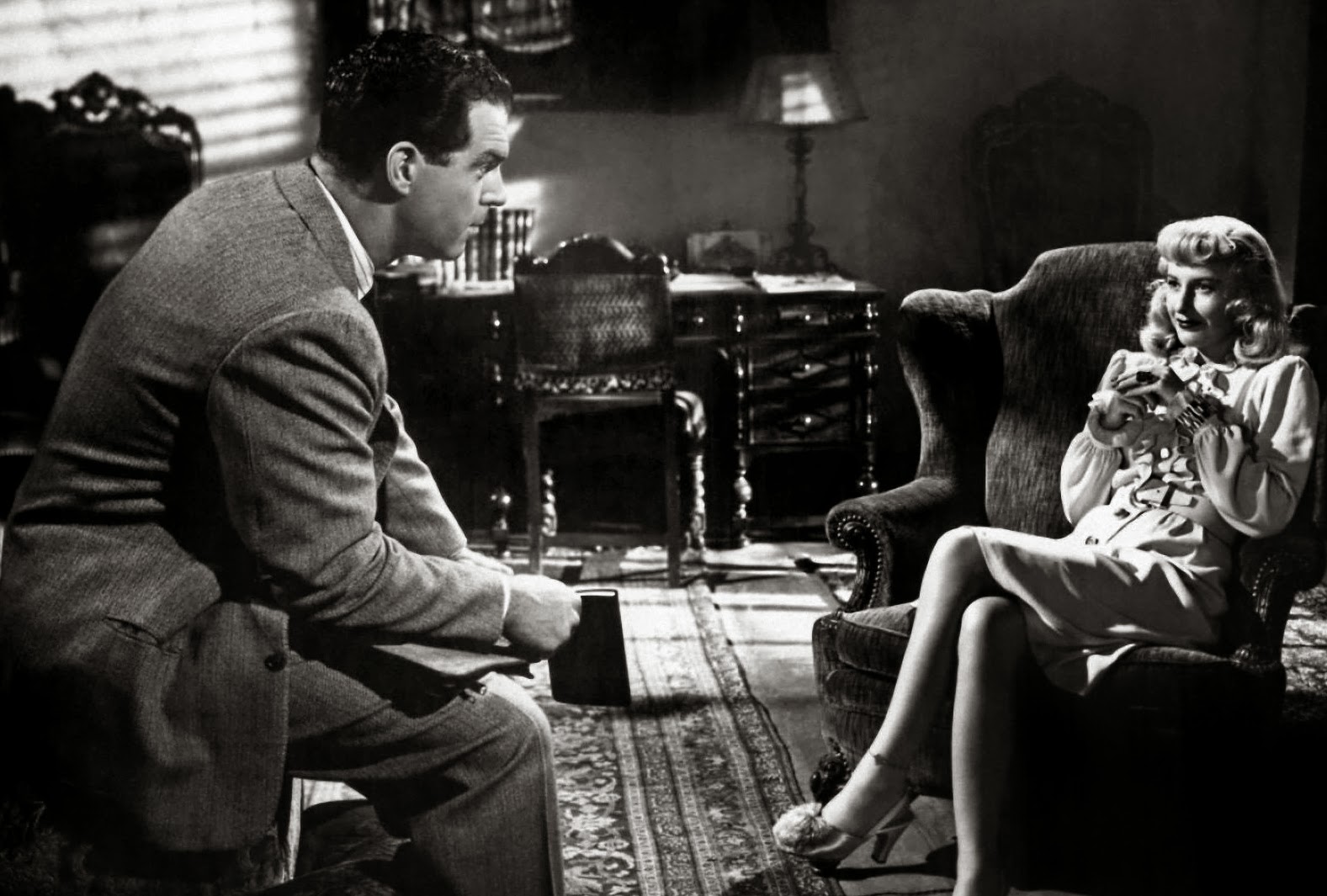
Double Indemnity (1944)

Fred MacMurray plays insurance salesman Walter Neff in this classic film noir from director Billy Wilder (who co-wrote the screenplay with Raymond Chandler, based on the book by James M. Cain). Neff is a good guy. He's a great salesman and also a colleague that claims investigator Barton Keyes (Edward G. Robinson) can depend on. That all changes, however, on the day that he meets Phyllis Dietrichson (Barbara Stanwyck). He's only visiting to get her husband (Tom Powers) to renew his automobile insurance policy, but Phyllis soon starts guiding the conversation towards life insurance and a policy she could get for her husband that would guarantee a big payout if, god forbid, anything ever happened to him.

Highly influential in all the right ways, Double Indemnity holds up today as a great slice of entertainment and a quintessential film noir. It was far from the first movie in that subgenre, but it's one that remains an almost perfect example containing many of the tropes and showing how to perfectly piece them together.

The one MINOR criticism I have is that the dialogue, so cool and great to listen to, quickly becomes a bit too unnatural. Mind you, after listening to an exchange like the entire first meeting between Walter and Phyllis, the many hits are worth the few misses. It's worth noting that, although it seems I am contradicting myself, at least 90% of the script is a joy to tickle and caress the earlobes.

MacMurray and Robinson are superb in their roles, with the former somehow managing to stay sympathetic and likable even as events take a turn for the worse, but this movie belongs to Stanwyck, who grabs her role with both hands and delivers a performance that film-makers have rightly remembered and tried to emulate ever since. There's also a lovely performance from Jean Heather, playing Stanwyck's stepdaughter, never warming to the woman with good reason.

Billy Wilder gave cineastes a number of classics throughout his career. This is one of them. The voiceover narration, the plot twists, the details teased out in the conversations, the performances, the secondary characters who get to make almost as much of an impression as the leads. I almost gave this 10/10, and many will argue that I should have, but that's the joy of us all having different opinions.

9/10

http://www.amazon.co.uk/Film-Noir-Collection-Kirk-Douglas/dp/B000UWXM1C/ref=sr_1_1?s=dvd&ie=UTF8&qid=1383510857&sr=1-1&keywords=film+noir+box+set