Showing posts with label billy wilder. Show all posts

Monday, 16 February 2026

Mubi Monday: Irma la Douce (1963)

I love many Billy Wilder movies. I love many Jack Lemmon movies. I also love many Shirley MacLaine movies. The three of them collaborated memorably on an all-time great back in 1960 so I went into this feature with no small amount of optimism. Friends did warn me though. Don't expect another The Apartment was the general advice. I like to think that I didn't go in with those kind of expectations. I certainly wasn't prepared for what I got though.

MacLaine plays Irma, a prostitute in Paris with a stellar reputation. Lemmon is Nestor, a young policeman who ends up losing his job after a very short time on the beat. With these two characters eventually falling for one another, it's not long until Nestor is in the tricky position of enjoying a good life afforded to him by his loving woman while also resenting what she does to earn her money. Without thinking of the full repercussions, Nestor comes up with an idea to approach Irma as a rich Englishman, one who will pay her so well for her company that she won't need to see any other clients. The major flaw, of course, is that Nestor then has to find a way to earn enough money to pay Irma for her time. As distance grows between them, Irma may well want to find out just how good a life she could have if she decides to head off into the sunset with her super-rich client.

Knowing that this was based on a French stage musical that originated in the mid-1950s helps to explain why some of the main names may have been attracted to this material, but it doesn't help to explain the many decisions made in adapting it from stage to screen. Not including any major song and dance numbers is one thing, but not doing enough to make the leads more sympathetic and amusing is something else altogether. Any major obstacles are of their own making, the whole thing is far too silly to even come close to being satisfyingly dramatic at any point, and, worst of all, the comedy often falls completely flat, soured by the central premise and the selfishness of the Lemmon's character. A couple of sequences in the third act work well, but they're too little too late in a film that greatly overstays its welcome with a runtime of 147 minutes.

Lemmon retains some likability, but that's more due to his own personality than anything written in the screenplay. MacLaine is good enough, but forced to remain oblivious to certain details that need to remain unknown to her for the unfolding plot to work. Lou Jacobi gets quite a few of the best lines, and the fact that he is the only other person to know about the ongoing scheme, and the problems caused by it, also allows him to comment on things with a level of insight and wit missing from the other characters. Other cast members worth mentioning are Bruce Yarnell ( a rival named Hippolyte), Herschel Bernardi (Inspector Lefevre), and Tura Satana (Suzette Wong, but mentioned here just for being Tura Satana). There's also a very small role for Bill Bixby, who will be easy to recognise for those keeping an eye out for him.

I might have liked this as a musical. That might have been enough to distract me from the many failings elsewhere, particularly when it comes to the lack of great dialogue and gags. It wasn't to be though. Maybe Wilder, who also wrote the screenplay with I. A. L. Diamond, knew that he wouldn't be the right person to helm this as a musical feature. Unfortunately, I don't think he was the right person to helm this at all. What it really lacks is a protective layer of whimsy and fantasy to cover up and smother the many jagged edges that make it impossible to warm to.

4/10

If you have enjoyed this, or any other, review on the blog then do consider the following ways to show your appreciation. A subscription/follow costs nothing.
It also costs nothing to like/subscribe to the YouTube channel attached to the podcast I am part of - https://www.youtube.com/channel/UCErkxBO0xds5qd_rhjFgDmA
Or you may have a couple of quid to throw at me, in Ko-fi form - https://ko-fi.com/kevinmatthews
Or Amazon is nice at this time of year - https://www.amazon.co.uk/hz/wishlist/ls/Y1ZUCB13HLJD?ref_=wl_share 

Monday, 13 October 2025

Bad Seed (1934)

AKA Mauvaise Graine.

If you want me to watch a film then telling me that Billy Wilder is involved is one easy way to do it. I was tempted by Bad Seed anyway, it seemed like a fun little crime flick, but then saw that it was the directorial debut of Wilder (credited here alongside Alexander Esway, although the involvement of Esway has since been mentioned as a way to simply secure financing).

Pierre Mingand plays our lead character, Henry, a young man who is upset when his father (Paul Escoffier) decides to stop funding his happy-go-lucky lifestyle and takes his car away from him.  Henry has a date to keep with a young woman, which is part of his motivation for stealing the car when he sees it parked up with the keys left in it. This sets in motion a chain of events that get Henry involved with a gang of car thieves, and has him growing close to Jeannette (Danielle Darrieux), the sister of young compulsive tie-thief, Jean (Raymond Galle).

While this is a feature debut, while it's a French film before he found his feet in Hollywood, and while it's a pretty lightweight bit of fluff, I would argue that there's still something here to signify the talent of Wilder. The dialogue may be more sparse than usual, but it's often quite sharp and witty (co-written by Wilder, Jan Lustig, Max Kolpé, and Claude-André Puget), and things are presented with a great blend of economy and assuredness.

Mingand is a decent leading man, and the rest of the cast make up a memorable selection of supporting characters as things start to focus in on the relationship between him and Darrieux, who is also very good at portraying someone criminal enough to be dangerous, but also happy to one day leave that life behind her. While I have already named Escoffier and Galle, it's also worth adding a compliment or two for Michel Duran, Georges Malkine, and Gaby Héritier, as well as Marcel Maupi, who plays someone desperate to see results from the police when he becomes a victim of car theft.

It's all quite predictable, and all quite safe (this is a crime thriller with some main characters you hope will see the error of their ways and start a new chapter in life before the end credits pop up), but it's also very easy to enjoy, particularly in a couple of main scenes that show how brazen the car thieves are. I would say that this is ripe for a modern remake, but suspect that it's a bit pointless when you consider how many of the individual elements here have been recycled and reworked in a variety of movies, from crime thrillers to rom-coms. If anyone DOES want to have a go at it . . . I'll be interested in seeing the final result. It might be hard to beat this version though.

8/10

If you have enjoyed this, or any other, review on the blog then do consider the following ways to show your appreciation. A subscription/follow costs nothing.
It also costs nothing to like/subscribe to the YouTube channel attached to the podcast I am part of - https://www.youtube.com/channel/UCErkxBO0xds5qd_rhjFgDmA
Or you may have a couple of quid to throw at me, in Ko-fi form - https://ko-fi.com/kevinmatthews
Or Amazon is nice at this time of year - https://www.amazon.co.uk/hz/wishlist/ls/Y1ZUCB13HLJD?ref_=wl_share 

Monday, 25 February 2019

Mubi Monday: A Foreign Affair (1948)

There's so much to enjoy in A Foreign Affair that the negatives end up being remembered more than the positives as you think of what could have been changed and improved to put this higher up in the rankings of Billy Wilder movies. It's nowhere near his best, and a couple of scenes really end up veering away from the delicately-balanced tone that the rest of the movie has, but it's still one to seek out and enjoy, not least for the central performances from Jean Arthur and Marlene Dietrich.

Arthur plays Phoebe Frost, a congresswoman from Iowa who arrives in post-WWII Berlin with a committee who are wanting to check on the American troops stationed there and to make sure morale isn't dipping too low. What they find is that most of the troops are having a good time, able to barter their supplies in exchanges that often leave them richer and trying their best to spend pleasant time in the company of beautiful German women they won't necessarily mention to anyone when they eventually get home. One such man enjoying his time there is Captain John Pringle (John Lund), and the lady he likes to spend company with is Erika von Schlütow (Dietrich), a cabaret singer AND former valued mistress of someone quite high up in the Nazi party. Captain Pringle wants to keep Erika safe, which may mean distracting the visiting congresswoman, and what better way to keep her off the sent of both of them than pretending to fall for her?

You may have guessed from reading that paragraph that this is an odd tale to work into a romantic comedy, yet work it into a romantic comedy it does. Despite the fact that Wilder has a knack for weaving gold from straw, he can't quite do enough here to transform this. The script, written mainly by Wilder, Charles Brackett, and Richard L. Breen (with work from Robert Harari, adapting a story by David Shaw), has some great lines scattered throughout but starts to crumble and fall apart in the third act. As things become more complicated, it also becomes less amusing and harder to enjoy. The first half should be difficult enough, built on the premise of visitors journeying around a war-torn city and realising just how unscrupulous and unfaithful many of the men stationed there are, but it bounces around between a variety of characters and locations to help distract viewers from the ugly heart of the matter. When everything focuses on the Arthur, Dietrich, and Lund, that's when the cracks start to appear.

It doesn't help that Lund isn't all that appealing in his role. He does okay, I guess, but the role really requires someone with more charm. Thankfully, the best moments involve either Arthur or Dietrich, or both in the same scene. Dietrich is at her sultry best, and gets to deliver a couple of enjoyable musical moments, and Arthur transforms throughout the course of the movie, stealing the whole thing with some absolutely wonderful drunk acting in a sequence that ends up being the last proper moment of fun in the film. Millard Mitchell is also enjoyable, playing a Colonel who knows more than he lets on for most of the film, and there are a couple of fun supporting turns from Stanley Prager and William Murphy, playing a couple of women-chasing soldiers.

If things could have been held together for the finale then this would have been another excellent Billy Wilder movie to recommend to all. As it stands, it's just a good Billy Wilder movie instead. Which is still ten times better than a hundred other movies you should choose to watch most days.

7/10

You can buy the movie here.
Americans can get it here.


Wednesday, 12 November 2014

Noir November: The Lost Weekend (1945)

Adapted from the novel by Charles R. Jackson, The Lost Weekend is a sensationalistic noir from director Billy Wilder, who also co-wrote the screenplay with Charles Brackett. It's about alcoholism, focusing on a man who already seems to know that he's happiest when at the bottom of a bottle, and there are plenty of obvious touches throughout the film, but when it hits the nail on the head, particularly during the final reel, it remains one of the best studies of alcoholism/addiction fuelled by disappointment and self-destruction that I can think of. Pair this up with Leaving Las Vegas and you'll never be tempted by the demon drink ever again.

Ray Milland is on top form as Don Birnam, the man who has almost everything that his heart could desire, were it not for the fact that his heart always desires one more drink, and then one more, and another one to chase it down. His brother (Phillip Terry) is set to take him away for a weekend that should help him dry out and recover, and the woman in his life (Helen St. James, played by Jane Wyman) is also supportive as he tries to mend his ways, but a thristy stubborn streak turns the whole plan on its head. While his brother and Helen head out for a while, Don takes the opportunity to purchase some alcohol and spend some time in a nearby bar. And then he just tries to keep swimming further and further into whatever pool of alcohol he can get his hands on.

What starts off as a relatively light, fun movie soon turns into something extremely dark, yet Wilder uses the dimmer switch so expertly that many viewers may not feel the true impact of the whole thing until they've had the room lightened again. The script and cast are both a huge help, but there's a lot to be said for his perfect balancing act. Too dark and the whole thing becomes unbearable, too light and it's meaningless.

Milland may show off all the tics and twitches that you'd expect in his role, but he excels in the scenes that show his desperation for another drink, at any cost. This is a character who can pretty much justify every action, no matter how far back he has to stretch, and Milland mixes in cruelty, remorse, cunning, and a healthy dose of pathetic. Wyman, on the other hand, is simply sweetness throughout. The relationship between the two may seem unlikely, yet it never seems completely false, especially as flashbacks show Milland hiding away his drinking habit in the early stages. Terry is very good, Howard Da Silva is a bartender who gives Milland a justifiable bit of attitude, and Doris Dowling is extremely likeable as a happy-go-lucky gal who has a bit of a crush on a man she doesn't see as he really is.

Powerful, at times uncomfortable, incisive and thought-provoking, The Lost Weekend shows just what a slippery slope any major addiction can be, somehow managing to avoid sensationalism and clumsy shock moments for the majority of the runtime. I consider it pretty much essential viewing, especially as a sobering (pun intended) look at the potential dangers of alcohol dependence.

9/10

If you have enjoyed this, or any other, review on the blog then do consider the following ways to show your appreciation. A subscription/follow costs nothing.
It also costs nothing to like/subscribe to the YouTube channel attached to the podcast I am part of - https://www.youtube.com/channel/UCErkxBO0xds5qd_rhjFgDmA
Or you may have a couple of quid to throw at me, in Ko-fi form - https://ko-fi.com/kevinmatthews
Or Amazon is nice at this time of year - https://www.amazon.co.uk/hz/wishlist/ls/Y1ZUCB13HLJD?ref_=wl_share 

Sunday, 3 November 2013

Double Indemnity (1944)

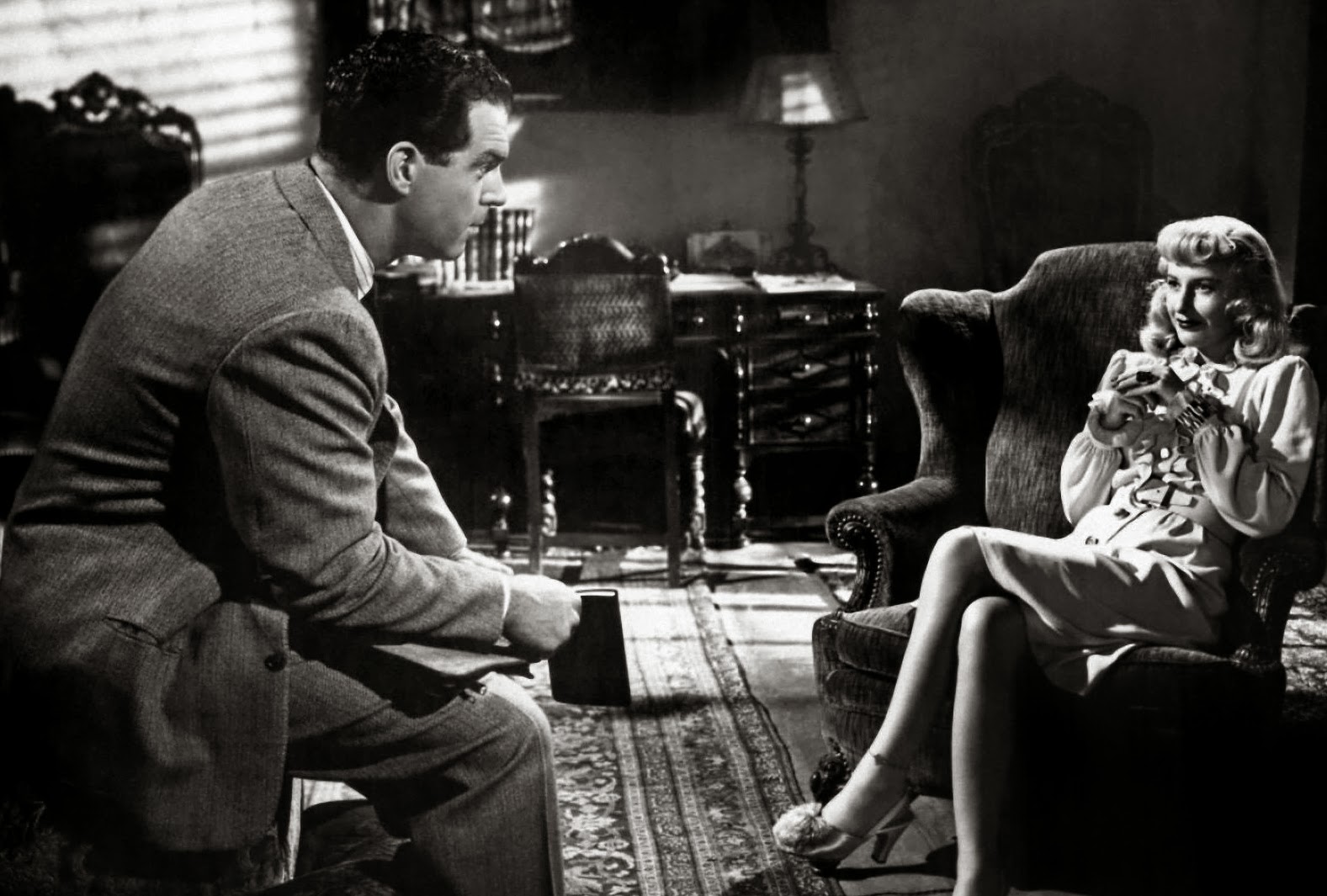
Fred MacMurray plays insurance salesman Walter Neff in this classic film noir from director Billy Wilder (who co-wrote the screenplay with Raymond Chandler, based on the book by James M. Cain). Neff is a good guy. He's a great salesman and also a colleague that claims investigator Barton Keyes (Edward G. Robinson) can depend on. That all changes, however, on the day that he meets Phyllis Dietrichson (Barbara Stanwyck). He's only visiting to get her husband (Tom Powers) to renew his automobile insurance policy, but Phyllis soon starts guiding the conversation towards life insurance and a policy she could get for her husband that would guarantee a big payout if, god forbid, anything ever happened to him.

Highly influential in all the right ways, Double Indemnity holds up today as a great slice of entertainment and a quintessential film noir. It was far from the first movie in that subgenre, but it's one that remains an almost perfect example containing many of the tropes and showing how to perfectly piece them together.

The one MINOR criticism I have is that the dialogue, so cool and great to listen to, quickly becomes a bit too unnatural. Mind you, after listening to an exchange like the entire first meeting between Walter and Phyllis, the many hits are worth the few misses. It's worth noting that, although it seems I am contradicting myself, at least 90% of the script is a joy to tickle and caress the earlobes.

MacMurray and Robinson are superb in their roles, with the former somehow managing to stay sympathetic and likable even as events take a turn for the worse, but this movie belongs to Stanwyck, who grabs her role with both hands and delivers a performance that film-makers have rightly remembered and tried to emulate ever since. There's also a lovely performance from Jean Heather, playing Stanwyck's stepdaughter, never warming to the woman with good reason.

Billy Wilder gave cineastes a number of classics throughout his career. This is one of them. The voiceover narration, the plot twists, the details teased out in the conversations, the performances, the secondary characters who get to make almost as much of an impression as the leads. I almost gave this 10/10, and many will argue that I should have, but that's the joy of us all having different opinions.

9/10

http://www.amazon.co.uk/Film-Noir-Collection-Kirk-Douglas/dp/B000UWXM1C/ref=sr_1_1?s=dvd&ie=UTF8&qid=1383510857&sr=1-1&keywords=film+noir+box+set