Showing posts with label western. Show all posts

Friday, 18 March 2022

Maverick (1994)

Springboarding from the old TV show (not one I have ever actually seen), Maverick is a comedy Western that coasts along on the charm of the leads, rejigs a lot of the classic Western tropes in ways that subvert them for comic effect, and entertains from start to finish. It's the kind of film that has the feeling of good humour and camaraderie emanating off the screen, and I think it's one that too many people seem to have forgotten about already.

Mel Gibson plays Bret Maverick, a cowboy who lives for the thrill of the draw. The draw of cards from a deck. He’s a gambler, and one who makes more money by acting naive. He also stays alive by acting cowardly, avoiding fights whenever he can. But being unwilling to fight everyone who wants a fight doesn’t mean that Maverick is incapable. He’s actually quick and sharp with a gun, and his wit. Alongside a couple of other main characters (Annabelle Bransford, played by Jodie Foster, among them), Maverick is aiming to get his place at a major poker tournament set to take place on a riverboat. He needs his entry fee, he needs to avoid people who are dead set against him taking part, and he needs to keep lady luck on his side.

Directed by Richard Donner and written by William Goldman, the marriage of expertise both behind and in front of the camera makes this a real treat. It’s easygoing - the more tense and dangerous encounters remain focused on being cinematic, without needing to add grit or any complete revisionism - and the story hits all of the expected beats without feeling tiresome. Goldman has given us better scripts, undoubtedly, but this is a film that really plays to his strengths, and subsequently rewards anyone who appreciates his writing skills (which should be pretty much everyone).

Gibson gives a star turn up there with the best of his star turns, charming and cheeky and always one step ahead of people who think he is two steps behind. He’s a reluctant hero, always making time to sigh and roll his eyes before endangering his life to help others. Foster isn’t quite as good, playing her scheming “Southern belle” character in a way that fails to light up the screen as it should. She improves as the film goes on though, and her comedy chops work better whenever she is verbally sparring with Gibson. James Garner is welcome in his strong supporting role, especially as he brings the baggage of his performance in the main role when it was a TV show, and the rest of the cast is stuffed full of great actors and faces from the Western genre. James Coburn, Dennis Fimple, Denver Pyle, Leo Gordon, and many others are all given some screentime. There’s a great villainous turn from Alfred Molina, a very fun cameo from Danny Glover, and a hilarious sequence with Graham Greene helping the main character to scam some money from a rich hunter. Add in small turns from Geoffrey Lewis, Art LaFleur, Dan Hedaya, and Max Perlich and you have a non-stop parade of great turns.

There’s also a playful Randy Newman score, a number of impressive stunts (including an excellent runaway coach sequence), players winning poker with hand that defy astronomical odds, and occasional glimpses of classic cowboy gun-handling. And it all adds up to a fun time, one that doesn’t even feel overlong with a 2+ hour runtime because you are rarely left without a smile on your face as things play out.

8/10

If you have enjoyed this, or any other, review on the blog then do consider the following ways to show your appreciation. A subscription/follow costs nothing.
It also costs nothing to like/subscribe to the YouTube channel attached to the podcast I am part of - https://www.youtube.com/channel/UCErkxBO0xds5qd_rhjFgDmA
Or you may have a couple of quid to throw at me, in Ko-fi form - https://ko-fi.com/kevinmatthews

Monday, 16 November 2020

Mubi Monday: Meek's Cutoff (2010)

Bruce Greenwood is not Ethan Hawke. I wouldn't normally start a review by saying that, but I wouldn't normally watch a movie thinking that one character has been played by Ethan Hawke, only to find they were played by Bruce Greenwood. 

Greenwood plays Stephen Meek, a frontier guide who leads a wagon train through some arid countryside, taking everyone perilously close to a sticky end, due to the ongoing scarcity of food and water. Tensions grow when a Native American (Ron Rondeaux) is captured, with different members of the group trying different ways to get him to reveal information to them about the surrounding desert environment.

Directed by Kelly Reichardt, and written by her regular collaborator, Jonathan Raymond, Meek's Cutoff is an attempt to tell a very strange story from history in a way that allows for a different kind of Western. The end result is a mixed bag, a film that strives to avoid all of the moments that you’re used to seeing in the genre. That is no bad thing, not in and of itself, but the fact that it so defiantly gives viewers nothing recognisable also works against it. There’s no playfulness here, no major subversion, despite the exploration of the shifting power dynamic between Meek, the Native Smerican, and others in the group.

The cast all do good work, even if I thought Greenwood was Hawke (which is a compliment for this role, honest). Michelle Williams and Will Patton are the main couple who don’t immediately dance to the tune that Meek wants to play, which is probably well-advised as it becomes clear that he may not know as much as he claims to know. Shirley Henderson, Paul Dano, Zoe Kazan, and everyone else in the group does solid work, and Rondeaux is superbly stoic and ambiguous in his way of interacting with the others.

Do seek this out if you don’t mind a slow-paced film that features some top-notch actors giving superb, but unshowy, performances. But it is worth warning people who decide to check this out if they are after a revisionist Western. You could label it that way, but it is more simply classed as a historical drama that happens to take place in a location more commonly seen in Western movies, with people who sometimes look to settle disagreements with their guns. Sort of like a Western.

7/10

https://ko-fi.com/kevinmatthews


Saturday, 5 September 2020

Shudder Saturday: The Wind (2018)

A horror Western that keeps two female characters at the front and centre of everything, The Wind is an interesting movie that mixes well-crafted scares with a character study that shows viewers a strong, pained, female character being taunted and terrified by a supernatural force.

Caitlin Gerard is Lizzy Macklin, a woman who lives in an isolated part of the American frontier with her husband, Isaac (Ashley Zukerman). They end up gaining some neighbours, Emma (Julia Goldani Telles) and Gideon (Dylan McTee), and things seem quite pleasant, if occasionally tense. Lizzy ends up trying to be helpful when everyone finds out that Emma is pregnant, but the characters are living during times that are far less forgiving to any problems in pregnancy. Which leads to Lizzy being left alone for some time, and having to confront something that doesn't want her to have any peace.

Although not ever quite as good as it could be, The Wind has a lot going for it, not least of which is the fact that this was written and directed by two women, both of them making their feature debuts, in the world of fiction film anyway. Director Emma Tammi has previously co-directed and directed a couple of documentaries, while Teresa Sutherland here makes the leap from shorts to a full feature, even if her writing here seems to expand upon The Winter, a short film that she both wrote and directed back in 2012. I've not seen that, but there's certainly a similarity in the plot summaries available online. Regardless of their respective past achievements, both director and writer seem very much in simpatico here, with Sutherland providing a thoughtful chiller that doesn't skimp on moments of full-on horror genre entertainment while Tammi overlays everything with visuals that show the kind of sparse beauty of the American West of this time, also getting the timing and visuals of the scares perfectly balanced to please horror fans without disrupting the earthy tone of the movie, a tale that never lets you forget the only thing keeping the main character from the dark danger outside is a wooden house and a small fire.

Gerard is very good in her role, understandably on edge for many scenes without ever taking her performance to the level of hysteria. Telles is also very good, and gives the air of someone who may want to have, or keep, a secret (although maybe she's just happy to be in a MUCH better film than Slender Man). Zukerman and McTee both do fine as the menfolk, neither one as supportive as he could be to either of the women, and Miles Anderson is a highlight as The Reverend.

So many Westerns are directed by men and about men. It is, like so many other genres (and, arguably, the whole world of film), an area so dominated by males that it's easy to forget just how many more interesting tales we could have, simply by switching the focus to the many women who also have to go on some difficult journeys. That's the biggest plus point for The Wind, in my view, but I wouldn't be heaping praise on it if it didn't get the horror genre elements right. It does though, and holds up as a title to recommend ahead of many others I have seen so far this year.

8/10

https://ko-fi.com/kevinmatthews


Monday, 8 April 2019

Mubi Monday: The Sisters Brothers (2018)

A bit of a change of pace for director Jacques Audiard, The Sisters Brothers is an enjoyable dark comedy Western that benefits immensely from two central performances from Joaquin Phoenix and John C. Reilly.

The two play the titular brothers, men who end up on a quest to chase down two men (played by Riz Ahmed and Jake Gyllenhaal) who may be on to a winning formula for gold prospecting. They encounter difficulties along the way, of course, caused by people who want to end their lives, and the excessive drinking of Charlie.

Although featuring all of the usual things you expect to see in a Western, this is atypical in the way the characters are shown and the situations developed. Our two leads are not on some honourable quest, for example. They are being sent after men by a figure known as The Commodore (Rutger Hauer). Loyalties change, character flaws are not fixed in any major moment of redemption, and you never expect anyone to ride off into the sunset.

Reilly and Phoenix may not be two actors you would think of pairing up as brothers but both work really well in their roles, with the former being slightly in the shadow of the latter, although both can step up to the mark when guns need drawn and the bullets start flying. Ahmed is very good as the young man out to make his fortune with brains over toil, and Gyllenhaal is equally good as the man who does his best to stick close to him. You also get a good selection of supporting players, with enjoyable turns from Rebecca Root, Allison Tolman, and the smallest of roles for Carol Kane.

The script, co-written by Audiard and his frequent collaborator Thomas Bidegain (based on the novel of the same name by Patrick DeWitt), is strong. Characters are fleshed out very quickly, with more being added to them as the plot winds from beat to beat, and there are some cracking lines of dialogue (a favourite of mine being Phoenix talking to the citizens of a town named Mayfield).

The direction is also strong, as you may expect if you've seen anything else from Audiard. He keeps everything feeling firmly rooted in the genre while giving most scenes enough of a little twist to make it all feel slightly different from the norm and fresh. There's also some typically wonderful music throughout from Alexandre Desplat (another favourite collaborator of Audiard) and some nice cinematography throughout from Benoît Debie, making a lot of the more unpleasant moments seem more palatable.

8/10

Here's a disc.
And Americans can get it here.


Friday, 2 November 2018

Filmstruck Friday: The Searchers (1956)

Well, not many of these left (sadly) but I'll keep going as long as Filmstruck is around.

Here's the cinematic journey I made when it came to Western movies, and I am going to boldly assume that a similar experience was had by many people of my age. I first saw Westerns as dull films, schedule-fillers put on at the weekend, after the fun of the programming aimed at kids and before any big sport shows. I'd sometimes be taken along to visit my grandparents, knowing that my grandfather was going to be more interested in how his horses got on for most of the afternoon, and there was often a Western movie on in the background as I tried to keep boredom at bay. The adults were all catching up, it was never a guarantee that any other kids would be there at the same time as I was, and all I seemed to see were the same barren, rocky landscapes, the same bland heroes shooting at some savage villains, and some good stunts on horseback. It's this experience that kept me away from Westerns for many years, even as I started to properly delve into all that cinema had to offer. The Western was the genre I enjoyed the least. Then I discovered Spaghetti Westerns, and the filmography of Clint Eastwood, and even the wonderful mix of romanticism and realism offered up by Kevin Costner (say what you like about his work, the man can craft a Western like a tanner crafts the finest leather goods). And, finally, I decided to check out those films that I had previously thought too dull, too stuck in the simple and old-fashioned roots of the genre. Yes, some of them still feel that way. But the ones that are still praised by fans so many decades later tend to, like enduring classics of any genre, hold up really well. The Searchers is one of them.


John Wayne stars as Ethan Edwards, a man who ends up spending a number of years on the trail of his niece, who was kidnapped by Comanches during a violent raid. He is accompanied on this journey by Martin (Jeffrey Hunter), the adopted brother of Ethan's niece who is also one eighth Cherokee, to the displeasure of Ethan. As they move through the country, viewers get served the expected helpings of action, but it all comes with an interesting look at race relations and the very thin line between violent heroism and outright savagery.

Based on a novel by Alan LeMay, The Searchers benefits from a cracking script by Frank S. Nugent that is given due respect by director John Ford. This could have been an easy movie to make a success without adding any complexity to the central plot strand, and I didn't expect all that I had to chew on as the movie ended, but Nugent and Ford balance things perfectly, right up to an ending so perfect that it quite rightly sits up there, I believe, alongside the greatest endings in cinema. You can spend years dissecting and discussing the portrayal, and misrepresentation, of Native Americans onscreen throughout the history of cinema, and this film doesn't avoid many of the common complaints you can level at 95% of Westerns, but Nugent and Ford spend a lot of time here showing Edwards up as being just as, if not more so, monstrous and bloodthirsty as the enemy he is pursuing. And it's not just Edwards. There are quite a few others who come along to show that savagery and immorality are not traits to be given to one section of society. In fact, there's an argument to be made that, for the most part, the Native Americans align themselves to a moral code more rigidly than a number of the standard white cowboys.

The more I see of John Wayne, after so many years avoiding him under the misapprehension that I would hate all of the movies he starred in, the more I like him. I am well aware of his personal views, which makes it all the more interesting to see him give such a well-rounded, and well-shaded, performance. He's the staunch hero here, apart from the times when he isn't. He's the guy who, in modern cinematic terms, knows that he has to get his hands dirty to get the job done. But he also would rather, at one point, consider shooting a young woman than see her live as a Comanche. Hunter does well to hold his own alongside "The Duke", he's a centre to the moral compass (or perhaps calling it a moral centrefuge would be better, considering the whirling nature of the main characters). German-born actor Henry Brandon does well as Scar, the Comanche Chief (I did say that it didn't avoid many of the common complaints), Vera Miles is lovely as a young woman waiting for the return of Martin, although a young man named Charlie McCorry (Henry Curtis) wants to win her over, Ward Bond is the authority figure who helps when he can, in a role that would nowadays be the angry Police Captain dealing with the rogue cop who gets results, and Natlie Wood makes a strong impression, despite being in the film for maybe a total of 5 minutes, tops.

I wasn't sure if I could overlook the negatives to rate this as a perect movie. The passage of time doesn't always feel that well done, it's tough at times to figure out why Wayne's character is so determined to set out on whatever course he chooses in reaction to certain events, and you have those problematic elements inherent in many films from this time. But those negatives are far too minor to dissuade me. The passage of time could have been better, sure, but that's about it, really. I liked not always understanding Wayne's character, sometimes admiring his steadfast way and sometimes loathing him. And as for the use of Brandon, and the portrayal of the Native Americans here, you always have to view cinema in context. In the context of the time, this still does a hell of a lot that you wouldn't expect.

It's no small irony that anyone asking me a decade ago if I would ever give a 10/10 rating to a John Wayne film would have heard the phrase so oft-repeated in this very film - "that'll be the day."
Yet here we are.

10/10

You can search out The Searchers here.
Americans can get it here.
Or just click on those links and buy everything you want.


Monday, 21 May 2018

The Good, The Bad And The Ugly (1966)

The action, the characters, the humour . . . how do you even begin to write a review of arguably the greatest, and most famous, Western ever made? Probably very, very badly. And it would certainly be superflous, compared to the many essays and tributes and articles already devoted to this masterpiece. But anyone who knows me already knows that I never let that stop me from adding my own witterings to the pile.

Clint Eastwood is the good, Lee Van Cleef is the bad, and Eli Wallach is tagged as ugly in this epic tale of bounty hunting, treachery, and a quest for a buried fortune. And that's all you need to know.

Although downright zippy compared to many other films from director Sergio Leone, this is another grandiose affair that allows the director plenty of moments to stretch out certain shots and scenes to almost unbearable degrees. It runs for just under 150 minutes, and if you're not grinning for at least 140 of them then I don't even know how to speak your language, because this is as rewarding and wonderful as cinema gets. It may not be sci-fi but you still feel transported to another world. It's live-action that sometimes feels wonderfully cartoonish. You get comedy, thrills, action, and some wonderful lines of dialogue alongside the standard Leone style of telling so much through actions and reactions. I tend not to mention the writers as much when reviewing Leone movies, because of how much is said without really being said, but the script here

Eastwood does some of his best work, as does the brilliant Wallach, while Lee Van Cleef seems to enjoy sinking his teeth into a role that is much more dastardly than his previous appearance in the trilogy. The supporting cast is bigger than in any of the previous films, but that doesn't mean there are many other central characters. This is all about our lead trio, even if we do also manage to get a fine, fleeting, turn from Luigi Pistilli.

And what would the lead performances and all of these gorgeous visuals be without an accompanying score from Ennio Morricone? They would still be gorgeous, no doubt, but Morricone's iconic music (can music be iconic? I am going to say yes) brings everything together with a score that is nigh on perfect. It doesn't matter how many times you hear it, "The Ecstasy Of Gold" should rightfully give you goosebumps, and that's only one section of a score that never puts a foot wrong.

For the artistry of it, and the themes explored, I only slightly prefer Once Upon A Time In The West, but I wouldn't argue with anyone who picks this as their favourite Western of all time. It is a classic, and a fitting swansong to one of the greatest cinematic trilogies ever made (and, yes, that even includes The Mighty Ducks).

10/10

I recommend buying this set.
Americans might want to try out this set.


Saturday, 19 May 2018

A Fistful Of Dollars (1964)

In a tale familiar even to those who have not already seen this classic movie (based, as it is, on Yojimbo, which itself was based on previous material which has since been recycled and revamped in so many different incarnations that it's almost impossible to keep track . . . . . . if ONLY there was some kind of website to make things easier . . . hmmmmm), Clint Eastwood stars as the famous Man With No Name (although a couple of the characters call him Joe, and he is listed here as such) who rides into town and begins clearing up a big mess by making a bigger mess. he does this with great ingenuity and balls of steel, putting himself in between two warring families and playing one off against the other while pretending that his loyalties are beyond question.

Everything is present and correct here that would go on to be improved upon and made completely iconic in Sergio Leone's future movies: the camera moving in for those close-ups of the eyes, the dusky damsel in distress, the gruff and economic speech from Clint, the sharp-shooting and moments of intermittent brutality. From the very beginning, with some lively animation and the first sounds of the wonderful Ennio Morricone score, you just know that you're in for a treat.

Clint is quintessentially Clint in a role that (alongside Dirty Harry) firmly established an iconic image for him. He may not have everything perfected yet (there's still a freshness to him and a slight hamminess in his laid-back manner) but he gets it almost spot-on and, of course, would just get better and better with the trilogy. The rest of the cast? Well, I would be lying if I said they were all memorable and how much I adored each performance but they all do a very good job at playing, essentially, ducks ready to be shot in a barrel. The friendly barman and eager coffin-maker are definite highlights but nobody really disappoints, despite maybe not searing themselves onto your psyche.

With a grandiose landscape just hovering by the edge of every framed moment, this starting point for (arguably?) the greatest Western trilogy ever made actually impresses all the more thanks to its ability to overcome any limitations with a smart, economical approach. It's clear in the scripting, in the moments of action and in the general details that the resources were definitely limited but that in no way detracts from the fun to be had while Clint smokes cheroots and cleans up the town.

The only real negative points here are, as already mentioned, Clint's growth into the role, the mixture of baddies (some are great, some aren't), and a child who appears just enough to annoy in the first half of the movie and who wouldn't seem out of place wailing amidst any Manga cartoon. Which marks this movie down from perfection. Which, ironically, kind of makes it better while you tag along for the ride.

9/10

I recommend buying this set.
Americans might want to try out this set.


Tuesday, 15 May 2018

Once Upon A Time In The West (1968)

Once Upon A Time In The West is, for me, the greatest Western of all time. It's better than anything else out there, including the masterful "Dollars" trilogy, also from Sergio Leone (as if you didn't know). It's not without problems, in terms of both pacing and attitudes towards certain characters, but the sheer scope of the film and grandiosity of it all is enough to keep me in love with this film forever.

The simple core of the story is about a Harmonica-playing man (Charles Bronson) who comes to a small town, intent on meeting up with a villain named Frank (Henry Fonda). He gets involved with a recently-widowed woman (Claudia Cardinale) who is of great interest to Frank, and the villainy and treachery of the plot also brings a charismatic criminal ('Cheyenne', played by Jason Robards) into the mix. There's more to it than that, however, and the script takes time to explore the progress of industry changing the types of crimes being committed, viewing the heroes and villains as archetypes on the very brink of extinction, something that can be viewed as good or bad, depending on how romanticised your view is.

Leone often makes me feel hypocritical. There are so many times when I view a movie and complain that a little editing wouldn't have gone amiss. I never think that with Leone movies, and this is the film to really test the patience of viewers who want fists and bullets flying throughout their Westerns. It's slow, to say the least. And I can understand people who find it interminably so. This is a film I urge everyone to see, yet it's not one I could recommend to anyone. Give it your time though, just once, and see how you feel. It's just under three hours in length, and feels longer to many people, but if you end up loving it as I do then you won't be bothered by the runtime at all.

Based on a story by Bernardo Bertolucci, Dario Argento, and Leone, the screenplay (co-written by Leone and Sergio Donati) is typically sparse. Which isn't to say that the dialogue is unimportant. Almost every line is essential, revealing something about the speaker, or allowing for some amusingly playful interactions, especially whenever Robards is onscreen. There's so much here to dig into that my small review won't begin to do it all justice.

The score by Ennio Morricone is as wonderful as any of his other works. Each main character has their own "theme", the harmonica tune becomes especially poignant when the backstory is revealed, and things really step up a notch just in time for the finale that viewers are waiting for.

As a side note, this was my first time seeing Once Upon A Time In The West on the big screen and I HIGHLY recommend the experience. Whether it was seeing a huge steam engine roll into shot or watching a massive side shot of Charles Bronson moving into the screen while the bombastic score signifies the beginning of the end, this was a viewing experience I'll never forget.

Everyone does well in their main roles. This was the film that finally showed me why so many people consider Bronson an iconic star, and he is. Claudia Cardinale is gorgeous and spirited, Robards steals almost every scene he is in, and Fonda is one of the great screen villains, an absolute bastard who viewers want to see get his just desserts from his very first scene. And there are some fun supporting turns from Gabriele Ferzetti, Lionel Stander, Paolo Stoppa, and Jack Elam and Woody Strode.

I can see why people have problems with this film. I can see why some will never like it. But cinema is a medium for the moving image and, by god, did Leone say more with visuals alone than almost any other non-silent director I can think of. If I was more academically-minded then this review would be the first in a series of essays exploring all of the choices made. But I am not. I am just a big fan who still gets goosebumps when I bask in the glow of a film that is THIS good.

10/10

I have, and love, this disc.
Americans can buy it here.


Wednesday, 4 June 2014

A Million Ways To Die In The West (2014)

I quite like Seth MacFarlane, despite the fact that he often sets off my Spidey-sense when he delivers gags that feel more mean-spirited than actually funny. Ted was a lot of fun, but a lot of good work,and goodwill, was undone by MacFarlane's stint hosting the 2013 Academy Awards. He just didn't seem as funny when not hidden behind a character.

The premise is standard stuff. MacFarlane plays Albert, a peace-loving sheep farmer living in the wild west. He doesn't really fit in there, due to his lack of courage and the fact that he's never fired a gun, but he's happy enough with his lady, Louise (Amanda Seyfried). Until Louise ditches him, claiming that she needs time to herself before quickly latching on to the dapper Foy (Neil Patrick Harris). Just when he's at a real low point, Albert meets the lovely Anna (Charlize Theron), a woman who decides to help him grow a spine and perhaps even win back the love of his life. Unfortunately, Albert and Anna grow close, which causes some serious friction when her husband, the outlaw known as Clinch Leatherwood (Liam Neeson), arrives in town.

Let's get straight to the point here, the biggest problem with A Million Ways To Die In The West is Seth MacFarlane. He directed the film, he co-wrote the script (with Alec Sulkin and Wellesley Wild), and he stars in the lead role. Despite weakness in all three areas, it's probably his attempt to be a leading man that drags the film down the most. He's just not a likable enough onscreen presence to hold together a movie. When not delivered from behind an animated curtain,  the gags and dialogue just come across as smug and obvious.

The rest of the cast try their best, with Theron particularly enjoyable for every moment that she's onscreen. Seyfried and Harris are fun, and Neeson does okay, but isn't given enough screentime to make a better villain. Giovanni Ribisi and Sarah Silverman are a loving couple, despite the fact that the latter works every day as a prostitute while convincing her man that they should both save their own sexual activity for when they get married. There are also some great cameos, with one being SO good that it almost made me want to give the movie a bonus point, but to name names would spoil the surprises.

But the cast can only take you so far. At just under two hours, A Million Ways To Die In The West is far too long and far too misguided in attempts to wring humour from the scenario. Oh, if people think that seeing a sheep's penis in detail before it urinates on someone is funny then they will enjoy themselves. Similarly, anyone wanting to see a hat pretending to be filled with liquid excrement might chuckle, but someone hoping to see the unnecessary shot of the hat being knocked so that the liquid excrement starts to spill out onto the ground will find that this is their dream movie. Oh yes, those "gags" are in the movie. Thankfully, a lot of the other gags are better, but not by much.

There's some nice cinematography, and the kind of rousing score that you'd expect from a Western, but those are the only two elements that MacFarlane gets right. There's no love here for the movies, and certainly little attempt to twist the tropes of the genre (other than the obvious High Noon stuff). And, worst of all, the whole thing constantly feels just like a movie. It's self-conscious at almost every turn, but also self-satisfied, which makes it feel lazy and irritating.

Feel free to disbelieve me and check it out for yourself, but this is yet another film that packs most of the best bits into the trailer (and at least one gag that wasn't present, which I'm sure will be shoehorned into the "unrated, even ruder, even more dangerous" extended version that will hit shiny disc). It's not really worth your time or money.

3/10

http://www.amazon.com/Million-Ways-Blu-ray-DIGITAL-UltraViolet/dp/B00KM9MP9I/ref=sr_1_1?ie=UTF8&qid=1401818195&sr=8-1&keywords=a+million+ways+to+die+in+the+west+blu+ray


Sunday, 17 March 2013

Tombstone (1993)

As is sometimes the way, Tombstone is a fantastic film that really seems to have defied some long odds to come together as well as it has. Kevin Jarre, who wrote the main script, was initially due to direct the film, but was fired just after he directed a number of scenes featuring Charlton Heston. George P. Cosmatos is the man who now has his name listed as director, but Kurt Russell played just an important, and maybe even more important, role in getting everyone back in the game and getting the movie finished. It's not surprising. Russell had a plum starring role in a movie chock full of great actors being allowed to do great things.

The film is all about Wyatt Earp (Russell) and his brothers (played by Sam Elliott and Bill Paxton) as they settle into life in Tombstone and try to enjoy some peace and quiet. Doc Holliday (Val Kilmer) is also in town and it seems like everyone may get to enjoy life a bit more with the days of being a lawman in Wyatt's past. But people don't always get what they plan for and Tombstone soon starts to see more and more violence in its streets, so much so that the pressure mounts for Wyatt to return to his old role. That is something that he just doesn't want to happen, but he may not have a choice in the matter if some of the more trigger-happy cowboys keep causing so much trouble.

Kevin Jarre's script was, apparently, pared down quite a bit from its initial size, but what's here is all good stuff. There are some superb lines of dialogue and characters are well sketched out. Despite how densely populated the film seems, everyone is given a decent share of the screen-time. Oh wait, that's not quite true. All of the men are given enough time and space, but most of the women in the movie are given fairly short shrift. Dana Delany fares better than most in the role of Josephine Marcus and Paula Malcomson and Joanna Pacula have one or two good moments, but Lisa Collins and Dana Wheeler-Nicholson needn't have bothered turning up, considering the little that they have to do. In fairness, the film is a look at Wyatt Earp and his friends and family and that famous gunfight at the O.K. Corral so decisions would have been made to keep the focus on the men about to get themselves involved in a historic shoot-out.

The direction, from whoever was in the big seat, is absolutely fine, but the cinematography, set design, etc. all pale in comparison to the work done by the casting department. Simply put, Tombstone has one of the best casts in a 1990s movie that you can think of. Let me just reel off the better-known names and see how long the list gets: Russell, Elliott, Paxton, Kilmer, Delany, Pacula, Powers Boothe, Michael Biehn, Charlton Heston, Jason Priestley, Stephen Lang, Thomas Haden Church, Michael Rooker, Harry Carey Jr, Billy Bob Thornton, Billy Zane, Wyatt Earp (you read that right, he's a distant relative of the lead character), Terry O'Quinn and the voice of Robert Mitchum.

Feel free to re-read that list and soak up just how much quality is scattered throughout it. The fact that, despite so much competition, this film ends up being owned by Michael Biehn and Val Kilmer, in their separate scenes and also any that see them sharing the screen, just shows how good those two actors are. One moment in particular, with Biehn's Johnny Ringo showing off his gun-twirling skill before being delightfully mocked by Kilmer, is up there with the very best in the Western genre (maybe even THE best, in my opinion). Russell is very good in the main role, as you'd expect, but Wyatt Earp is the unshowy, earnest heart while Biehn and Kilmer get to be a lot more flamboyant and fiery.

While not an entirely perfect film, Tombstone somehow manages to put so many individual great moments together that it feels almost like an instant classic. It becomes more than the sum of its parts, but that's because all of those parts are so well cast.

9/10

http://www.amazon.co.uk/Tombstone-The-Directors-Cut-DVD/dp/B001QOGXPU/ref=sr_1_1?ie=UTF8&qid=1363068604&sr=8-1


Tuesday, 26 February 2013

Django (1966)

Django is a name that has towered over the Western genre for many years before Quentin Tarantino decided to take it and put it to the masses with the fantastic Django Unchained. I'm sure that many people will now seek out the older movies thanks to the major homage from Tarantino and that can only be a good thing, especially when the film holds up as such fine, influential, entertainment.

Django (Franco Nero), the titular hero, is a gunslinger who walks around dragging a coffin behind him. This, as you can imagine, makes for some strong imagery. In the first moments of the movie he guns down some men who are attempting to punish a woman named Maria (Loredana Nusciak). It turns out that Maria is a prostitute who has been caught in between a rock and a hard place, in the shape of Major Jackson (Eduardo Fajardo) and General Hugo Rodriguez (Jose Bodalo), two enemies who have been ruining a town caught up in the midst of their ongoing battles.

It may not have been the first of its kind, but it's hard to argue against the fact that Django is the most important and influential Western of its time. It certainly spawned enough sequels (both official and unofficial) and imitators, as did the classic Leone Westerns from the same period. Film fans can enjoy the movie, but they can also take great pleasure in spotting every moment and scene that has since been homaged in other movies (and not just by Tarantino).

Franco Nero is great in the main role, every bit as cool and mesmerising as Eastwood ever was. It's no wonder that to many people he will always be the character, despite how many others have played him, or variations of him. Loredana Nusciak is a suitably appealing damsel in distress, Angel Alvarez is great as the bartender who wants to keep his life as well as his bar and Eduardo Fajardo and Jose Bodalo are entertaining potential villains, depending on how they deal with Django.

Behind the scenes, Sergio Corbucci is the man responsible for this enduring creation. Not only did he direct the film, but he also wrote the screenplay with his brother, Bruno Corbucci, and a few other helpful scribes. Then there's Luic Bacalov, the man responsible for the superb score, who also deserves a fair bit of praise and Enzo Barboni does a good job with the cinematography. Ruggero Deodato fans will probably already know that he was an assistant director on the movie and it's certainly a worthy entry in his filmography even if he's not getting the biggest credit.

While it was never the most obscure movie, it's good to know that more and more people will discover this film after yet another cinematic love letter from Tarantino (love or hate his work, he does his best to point people towards the movies that he's always loved). Django isn't a great spaghetti Western, it's not a great movie for its time, it's not something to be viewed just as a hugely influential work of art. Django is a great movie, period.

9/10

There have been some criticisms of the Bluray release so fans may just want to opt for the DVD here until the film gets the treatment it so deserves - http://www.amazon.co.uk/Django-Newly-Re-mastered-Region-DVD/dp/B00ABH20HI/ref=sr_1_2?ie=UTF8&qid=1361482202&sr=8-2


Thursday, 10 January 2013

Unforgiven (1992)

Unforgiven is an astonishing film, truly astonishing. Taking a great script and adding the baggage of Clint Eastwood's entire Western filmography, it makes for a fitting finale to that particular aspect of his career. From start to finish, the movie fills every scene with a love for the genre and an intention to show the flip side of that lifestyle. Many movies end with a gunslinger riding off into the sunset, but this one picks things up years later and shows how men who have killed other men can hold something inside them for the rest of their days, a mixture of regret and also the knowledge that they can easily kill again if the situation calls for it.

Eastwood plays Will Munny, a man with a violent past who has tried to make a new life for himself. He has children and stays true to his deceased wife. Unfortunately, his violent past doesn't always lead to him having a quiet life and that's the case when he's approached with an offer by 'The Schofield Kid' (Jaimz Woolvett). A couple of men were responsible for cutting up a whore (played by Anna Levine) and the other working girls in town weren't too happy with the punishment they received from Little Bill Daggett (Gene Hackman). Strangely enough, Bill normally metes out far worse punishments to anyone he sees as a threat to his idyllic vision of the town. He doesn't even allow anyone to enter with guns on their person, which doesn't bode well for the likes of English Bob (Richard Harris). It also doesn't bode well for The Kid, Munny and Ned Logan (Munny's friend, played by Morgan Freeman).

Unforgiven sees Eastwood hitting it out of the park in his role as director and, when you think of how well he's done in his directorial career, that's high praise indeed. It helps that he also does great in the acting department and surrounds himself with fine talent (Freeman, Hackman and Harris do some of their best work, there's a great little role for Saul Rubinek and Woolvett, Levine and Frances Fisher, playing mother hen to her girls, all do sterling work). Then, there's the great script by David Webb Peoples. It's full of quality lines and character moments that are often mesmerising (I should rave more about Hackman and Harris, both outstanding with the former, in particular, getting his teeth into an interesting villain who is given an interesting complexity and sense of morals). And everything is turned into pure gold when the distilled essence of Eastwood's years in the Western genre is added to the mix.

The film is both a love letter to every movie that has ever feature a gunslinger on-screen and also a serious and moving study of how a man who spends his life doing bad things can ruin any future chance of happiness and contentment that he may one day hope for. It is ultimately, of course, about the deeds and the people and even the reflections in the mirror that are unforgiven.

10/10

http://www.amazon.co.uk/Unforgiven-Blu-ray-Region-Free/dp/B000RWDXDC/ref=sr_1_2?ie=UTF8&qid=1355953348&sr=8-2


Thursday, 22 November 2012

True Grit (1969)

John Wayne. He was the ultimate macho man to many people and could always be relied upon to show the very best assets of being a man completely in line with the will of Uncle Sam. I have never been a fan but that's just because I've never seen any clips of his acting in which he wasn't just the swaggering bull of a man that he so often portrayed. Finally seeing the original True Grit after I'd enjoyed the remake so much, I realise that I should make an effort to watch the films of someone who made such a big impact on cinema audiences. He's an icon and icons are usually icons for good reason.

True Grit is a wonderful film with some fine performances in there and the turn from Wayne, as grizzled and oft-drunk Rooster Cogburn, is the highlight of the film. In fact, it gave him his only Oscar win. There may have been worthier candidates that year but it's hard to begrudge him the win after he gave audiences so much pleasure over the years.

The story here is all about young Mattie Ross (Kim Darby) looking to hire someone who will hunt down the murderer of her father. She gets Rooster Cogburn and offers him some money to do her bidding. He takes her up on the offer but then tries to get her to stay behind and wait while he heads off with a Texas Ranger named La Boeuf (Glen Campbell) to catch some crooks and collect some rewards. However, young Mattie isn't going to stay put and she wants everything resolved her way. It doesn't take long for anyone who meets this young woman to realise that she often gets what she wants.

Based on the novel by Charles Portis, True Grit has a fine screenplay from Marguerite Roberts and capable direction from Henry Hathaway yet it's hard not to think that the movie is really lifted by all of the performances. Wayne is fantastic, being both a hero and sometimes a drunken ass. Darby is superb as Mattie Ross, a young girl easily able to shame and correct anyone trying to pull a fast one on her, and Glen Campbell is perhaps the weakest of the trio but an essential part of the group dynamic. Jeff Corey is the main man being hunted but film fans will probably get more enjoyment from watching a young-ish Dennis Hopper in a small role and the great Robert Duvall playing the villainous Ned Pepper.

The cinematography and visual style may be indistinguishable from the hundreds of other Westerns made during this decade but that doesn't detract from the fact that so many people hold up True Grit as a classic because it IS one. See, and enjoy, it for yourself.

9/10

http://www.amazon.co.uk/True-Grit-Blu-ray-Region-Free/dp/B004E10Q9G/ref=sr_1_5?ie=UTF8&qid=1353517747&sr=8-5


Sunday, 2 September 2012

The Great Train Robbery (1903)

Well, one a week. If I carry on at this rate I should be able to see all 1001 Movies To See Before You Die in the next 20 years. Which ensures that I won't die before the age of 56. That'll do me.

There's the usual link below to a potential purchase but, as is the case with many of the very, VERY old landmarks of ancient cinema this is also in the public domain and available to watch in a number of incarnations on YouTube. I went for this version.

The tale is quite a simple one, it's summarised by the title. Some bandits go about being bandits and they rob a train. However, while they're enjoying themselves and feeling smug and rich, some folks soon get on their trail and make a concerted effort to retrive the stolen goods. And then everything ends with footage of a bandit shooting at the screen, an image that shook audiences up back when the film was first released - they thought they were really going to be shot at, apparently - and is so iconic that Martin Scorsese recreated it with a gangster replacing the cowboy figure at the very end of the superb Goodfellas.

If you're a fan of cinema, the history of cinema and the landmark works that have helped progress the medium through over a century of entertainment then The Great Train Robbery is something worth seeing. It has a definite narrative, contains some decent effects and exterior shots (which were a lot more difficult to film at the turn of the last century) and stands up today as a truncated blend of popular tropes of the Western genre.

In terms of imagination and sheer entertainment value, it doesn't compare with the likes of A Trip To The Moon but it's certainly pretty well-crafted and an equally important stepping stone for the movies. Indeed, we may have director Edwin S. Porter to thank for everything that has come along in the genre since then - from Stagecoach and High Noon to Unforgiven and Open Range. And that's quite an achievement indeed.

7/10

http://www.amazon.co.uk/Great-Train-Robbery-Region-Import/dp/B0000WN1JA/ref=sr_1_7?ie=UTF8&qid=1346575792&sr=8-7


Sunday, 24 June 2012

A Fistful Of Fingers (1995)

The first feature (just) from Edgar Wright sees the man perhaps biting off a little bit more than he can chew in this Western spoof filmed in and around his hometown.

The story? "No-name" (Graham Low) travels in search of The Squint (Oli van der Vijver) for reasons that we don't know but that we hope will become clear by the end of the movie. That's it. Along the way, "No-name" meets up with Running Sore (Martin Curtis) but any actual development of the plot only serves the set-up and delivery of more gags.

Okay, so it may not be up there with many of the later outings from Wright in his professional career but his first big-screen outing as writer and director remains a surprisingly enjoyable experience that shows a lot of love and care far outweighing the meagre budget and resources.

The Western clichés are adhered to, or subverted, with glee (my favourite being the saloon that gets noisy and lively when a stranger enters and then becomes paused when he leaves again) and while they may not be the biggest or most sophisticated gags in the world I'd have to give props to Wright for the sheer wealth of comedy that he tries to cram in there. I was smiling a lot and one or two moments still managed to make me laugh out loud - a woodland gunfight being one of the best.

The actors, and accents, are pretty bad but they all go along with the nonsense and deserve points for simply doing their bit to help the movie get made. Jeremy Beadle and Nicola Stapleton are the only two faces I recognised from elsewhere, with the former popping up to provide a great gag if you remember Beadle's About. Oh, and Mr. Wright himself appears on screen briefly but I'm sure he doesn't put this appearance at the top of his C.V.

The self-deprecating director often points out the many flaws in this film and uses it to cite examples of what not to do with your low-budget first feature but I'd say that he's being a bit too hard on himself. This stands up as a daft little film that remains a bit of fun for those who get to see it.

6/10

It's a very, very tricky movie to track down but here's an optimistic link anyway

http://www.amazon.co.uk/A-Fistful-Fingers-VHS/dp/B00004CT72/ref=sr_1_1?ie=UTF8&qid=1340563145&sr=8-1 


Sunday, 29 April 2012

Guns Of Diablo (1965)

The kind of movie that used to crop up regularly on British television on a Sunday afternoon back when you only had access to four terrestrial channels and you spent half of your weekend either snoozing after a hearty lunch or creeping around those who were snoozing after a hearty lunch, Guns Of Diablo is an enjoyable enough time-waster that doesn't ever really do enough to earn itself a reprieve from the obscure status it now finds itself in.

Charles Bronson (aka THE Hollywood Cowboy) stars as Linc Murdock, a man who leaves his group temporarily to get supplies and sort out some affairs in a nearby town. He takes along a very young Kurt Russell (playing Jamie McPheeters) and the movie feels like a nice, pleasant family romp. Not for long though. Things take a turn for the worse when Linc spots the beautiful Maria Macklin (played by Susan Oliver) and we're then treated to a lengthy flashback sequence that explains their past. A past that's about to cause a lot of trouble for them in the present. Some think that Linc has debts to pay and they mean to collect.

Based on a novel by Robert Lewis Taylor, Guns Of Diablo is a mix of standard childish adventure and more serious adult gunslinger fare and the mix ends up detracting from the final creation. It's not energetic and innocent enough throughout to make the childish parts as enjoyable as they could be while the adult fare isn't quite grim and serious enough for fans of the Western genre who have already seen 101 movies using this familiar material to much better effect.

Director Boris Sagal and screenwriter Berne Giler don't add anything to the ingredients to help transform them but they're lucky to have Charles Bronson in the lead role and a very chirpy and likeable young Kurt Russell by his side. Susan Oliver is watchable enough, as are Jan Merlin, John Fiedler and Douglas Fowley, and the overall casting of the film provides the best reason for wanting to give it a watch.

6/10

http://www.amazon.com/Guns-Diablo-Charles-Bronson/dp/B0015RTB3Y


Saturday, 7 April 2012

The Wistful Widow Of Wagon Gap (1947)

AKA The Wistful Widow.

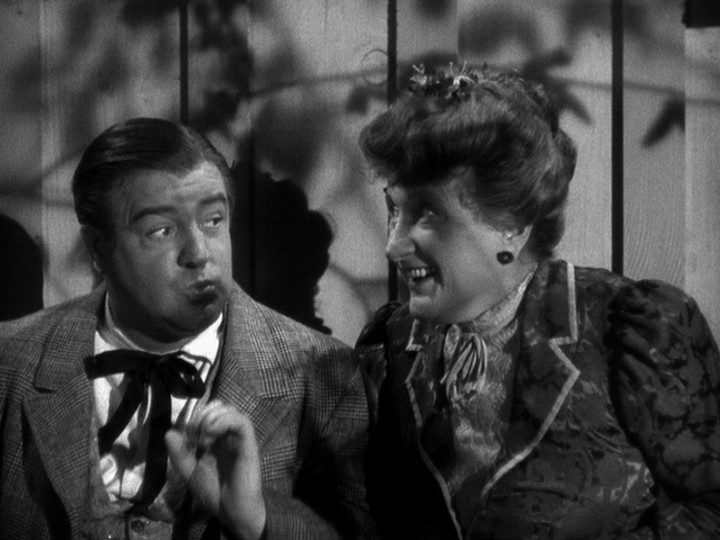
One of the best movies starring Abbott & Costello, this comedy Western contains a great mix of verbal and physical humour and has considerably less of the annoying mugging and childish behaviour that Lou Costello had been making his trademark over the preceding decade. He's still a naive and nervy "little boy" but doesn't need to make funny whining noises and/or do a double-take every two minutes.

The plot sees our two leads heading in to a dangerous town to try and make a buck or ten. They're only there for a few minutes when someone dies and Lou gets blamed for it. Thankfully, instead of being given a death sentence the two men are ordered to support the widow and family of the deceased and to help pay off the dead man's debts. This is demoralising and tiring for Lou, who has to work from sunrise to sunset, but things take a turn for the better when he realises that nobody wants any harm to come to him. Why? Because if they are found responsible for his death then they have to take over the responsibility and put up with the fearsome widow. Having found the secret to becoming almost untouchable, Lou is made the sheriff of the town and begins to enjoy himself a little. But there's always going to be a time when a sheriff, even an apparently untouchable one, will get into some serious trouble.

Director Charles Barton gets plenty right here. The script (by John Grant, Robert Lees and Frederic I. Rinaldo) helps a lot, as do the performances, but Barton brings everything together in just the right amounts. Abbott and Costello fans will enjoy the standard A & C comedy but there are also many moments for fans of standard Westerns to enjoy.

Marjorie Main is very entertaining as Widow Hawkins, as is George Cleveland (who plays the Judge), while Gordon Jones, William Ching, Audrey Young and the others onscreen all do very well. The two leads, as already mentioned, are on top form with a mix of one-liners and enjoyable physical comedy.

Definitely a movie that fans of A & C will want to see and, hopefully, love as much as I do.

8/10.

http://www.amazon.com/Abbott-Costello-Complete-Universal-Collection/dp/B001EXE2Y2


Monday, 26 December 2011

Ride 'Em Cowboy (1942)

Really, if you can't read the title of this Abbott & Costello movie and figure out just what kind of situation(s) they're going to end up in then you clearly haven't seen any of their first few movies. The boys are a couple of vendors who end up hotfooting it to some proper cowboy & indian territory. Then Lou accidentally fires an arrow through a tepee that means he should marry the lady within, there are a few musical numbers, some comedy stuntwork on lively horses and some amusing moments and misunderstandings with animals. There's a limp plot about Bronco Bob Mitchell (Dick Foran returning after his stint in Keep 'Em Flying) not really being a cowboy and trying to put things right with a lovely woman (Anne Gwynne) but there is also some enjoyable wordplay and the film debut of Ella Fitzgerald, who provides the two musical moments that are actually decent as opposed to the weak numbers sung by Foran or 'The Merry Macs'.

Arthur Lubin is once again in the director's chair and everyone knows the drill by now. The lads are introduced, there's a bit of wisecracking in between the set-up material, and then it's on to the adventures. The screenplay by True Boardman and John Grant is fine but the movie, perhaps surprisingly for those used to the style of the duo, works better in the physical moments than it does with the verbal exchanges. Lou trying to milk a cow provides plenty of laughs, though there are plenty of misunderstood phrases helping things along there, while an unexpected horse ride and an eventful chase sequence during the finale really stand out as great set-pieces. It's just a shame that the rest of the film didn't hit the same heights.

A & C are as good as ever (or as bad as ever, if you don't like them then you're not going to find anything here to change your mind), Dick Foran is okay but a bit too bland this time around and Anne Gwynne is very easy to like. But it's Ella Fitzgerald who stays in the memory after the credits have rolled, with her energy and her great voice. I'd say that fans of the lady should, despite her limited screentime, add a point to my final rating.

6/10.

If you have enjoyed this, or any other, review on the blog then do consider the following ways to show your appreciation. A subscription/follow costs nothing.
It also costs nothing to like/subscribe to the YouTube channel attached to the podcast I am part of - https://www.youtube.com/channel/UCErkxBO0xds5qd_rhjFgDmA
Or you may have a couple of quid to throw at me, in Ko-fi form - https://ko-fi.com/kevinmatthews
Or Amazon is nice at this time of year - https://www.amazon.co.uk/hz/wishlist/ls/Y1ZUCB13HLJD?ref_=wl_share